Tips from an early years Story Sharer: delivering an engaging storytime
As part of Story Sharer Week, we asked Marian Lowndes Sanderson from City of Doncaster Council Central Family Hubs how she and her team create impactful storytime sessions for families using Jump About with Ted by Sophy Henn – included in the BookTrust Storyteller Backpack

Hello everyone. My name is Sophy Henn, and I write stories and I draw pictures to go with them. And one of the series of stories I have written and drawn is this, the Ted board book series.
Now, Ted is a little boy with a big imagination. So let’s find out where that imagination takes Ted today, in Jump About with Ted.
Are you sitting comfortably? Then I shall begin.
Hey, Ted, what are you up to today? “Ha ha!” says Ted, “Look at me. I’m bouncing about like a fluffy snuffly bunny!”
Bounce, bounce! Snuffle.
Hey, Ted, are you still bouncing like a bunny? “Oh, no!” says Ted. “Now I’m springing up and down like a lovely woolly lamb!”
Spring, spring, baaa.
Hey, Ted, are you still springing like a lamb? “Course not,” says Ted. “I’m leaping around like a funny, croaky frog”.
Boing, boing, gribbit.
Hey, Ted, are you still leaping like a frog? “Not now,” says Ted. “Can’t you see? I’m hopping everywhere like a cuddly, chirpy chick!”
Hop, hop, chirpy cheep.
Hey, Ted, are you still hopping like a chick? “Hee hee,” says Ted, “Come and see. I’m jumping about with all my bouncy friends!”
Snuffle, baaaa, gribbit, cheep.
Well, Ted and all of his friends had a lot of jumping fun. Did you jump around too? Maybe.
Well, I really hope you enjoyed that story. Thanks so much for watching. Bye!
Make a plan around the story’s themes, phrases and actions
“As a team, we’d watch this video to get some ideas for sharing the story during Wriggle and Rhyme Time, as well as linking it to the wider Stay and Play session afterwards.
“We’d start by looking at themes in the story. For example, with Jump About with Ted, we may focus on the animals mentioned. We’ll think about which animal-themed nursery rhymes we can incorporate, and how we could have a basket of props and animal puppets to support the story.
“We’d look at repeated phrases, and how we can repeat those in our choice of nursery rhymes to support speech and language.
“This story is filled with actions like bouncing and jumping, so we might plan to do some action songs. We might also use Lycra to bounce the puppets up in the air.
“A variety of languages are spoken at our family hubs. We may get a few key words from the story translated into these languages alongside pictures and laminated onto signs – things like animal names and actions. We find this really does help families feel included in the storytime.”
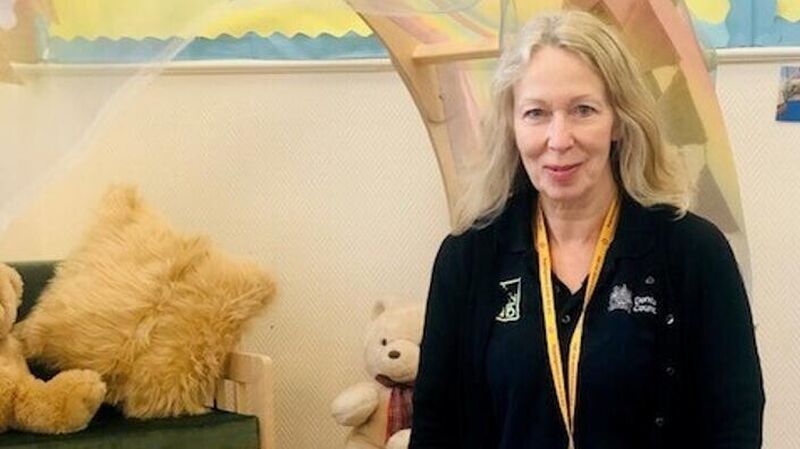
Marian Lowndes Sanderson from Doncaster Family Hubs
Rehearse your performance – and pair up to boost confidence
“For those who maybe feel a bit nervous about reading out loud, watching this video and seeing the way Sophy Henn reads her own story may help give some ideas for how to do the same. She’s very enthusiastic about getting the story across and that’s what we need to remember, it’s the enthusiasm that works.
“Give yourself a chance to read the book through properly before the session. Really think about the words that are being shared in the story. How you can use your voice to be more expressive. What facial expressions could you do?
“Even if you feel a bit foolish making faces and noises, the children don’t think it’s silly, they’re going to love it, because you’re bringing the story to life.
“If not everybody is feeling confident about reading stories, we tend to pair up, so that person can be more of a supporting role, or they can lead the nursery rhymes instead. Seeing a more experienced team member reading the story can help their confidence to grow.”
Get families on their feet – and take your time
“Always aim to involve the families in the storytime. Where possible, having a copy of the book for each family as we’re reading the story really helps them to focus.
“We make sure we get families up and moving, supporting their child, doing the actions themselves. That really encourages children to join in.
“The storytime gives them ideas about how they might share the story at home. If families don’t feel confident, we encourage them by saying: ‘You don’t have to read the whole book every time, just maybe focus on one page. Or, just focus on doing the animal sounds.’
“When you’re reading the story out loud, remember to pause. We tend to all read too fast, and the temptation is to rush onto the next activity right away. Just give children that bit of time to process the story and the words. We also repeat the same book several times in the same session.”
Connect the story to the play afterwards
“After the story has been told, keep the connection to it alive through play activities. How could you set up the props that you’ve used during the storytime for Stay and Play? Or could you create something different for families to explore afterwards?
“For example, with Jump About with Ted, you could have a farm set up in the small worlds corner. You could have the same puppets you’ve used placed in a basket with the book in the book corner – as well as some other books about animals. Maybe outside they could do a little assault course with actions from the story, like skipping and jumping, so you’re reinforcing the actions they’ve learned.”
Inspire families to continue the fun at home
“We would provide a link to the video of Sophy Henn reading Jump About with Ted for families to access themselves at home. We might share it on our social media pages or have it as a QR code on a leaflet.
“It’s so lovely for families to see the person behind the story, and to see the author reading their own book. The way Sophy reads in this video is so animated, and I think this would really come across to families.”
-
Tips, guidance and inspiration for using our early years programmes in your work
-

Advice for gifting BookTrust packs to families