Featuring expert members of BookTrust’s books team, this module offers practical guidance to help teaching assistants select high-quality texts. The training supports settings in creating rich reading environments by strengthening practitioners’ book knowledge.
Book selection and knowledge: free CPD training module for primary teaching assistants
This resource focuses on the importance of book selection and book knowledge in the early years and Key Stage 1.
Learning objectives
This professional development support resource focuses on the importance of book selection and knowledge for children’s engagement with reading:
- Understand the importance of selecting high-quality, age-appropriate books.
- Understand the importance of representation and providing a range of culturally diverse literature.
- Apply strategies based on growing book knowledge which support children’s reading progression.
National curriculum
“Pupils should have extensive experience of listening to, sharing and discussing a wide range of high-quality books with the teacher… to engender a love of reading.” “All pupils must be encouraged to read widely across both fiction and non-fiction.”
page 14
EYFS statutory framework
“[Language] only develops when adults talk with children about the world around them and the books (stories and non-fiction) they read with them.”
page 10
Reading framework
“Teachers and English subject leads might identify a core set of literature for each year group that can either be read aloud in story times or read by pupils in English lessons, including high-quality contemporary and classic texts: fiction, non-fiction, poetry and prose. Teachers should also engage their pupils in choosing new books. Refreshing the list of core books regularly, as new books are published and new teachers arrive, will avoid its being set in stone.”
page 88
Books as teaching tools
George talks about the importance of early reading and provides advice on how to make books accessible to all children.
Recent research suggests that there’s a massive drop off in reading especially as children progress from the early years up into Key Stage one and beyond as they leave the reading requirements of phonics and become independent readers. And this unfortunately has a knock-on effect on attainment and well-being.
We know that children are three times more likely to have high levels of mental well-being if they are reading from an early age. So it’s absolutely vital that we catch children at an early age, get them enthusiastic about reading and introduce them and encourage them to get into the world of reading.
So one of the ways educational settings can do this is by providing choice and access to high quality and diverse books. We unfortunately know that many children don’t have access and ready access to books at home. So, it’s vital that schools get rid of that barrier by providing loads and loads of high-quality books that children can access, borrow, read at school, and take home to enjoy with their families at home.
So, it’s vital that educators, all educators, take that into account and have a really good working knowledge of high quality texts, what children enjoy, and they use their knowledge of the children in their care to recommend and get them involved with the books that they might enjoy.
So, in your setting, you might have children who really enjoy animals and learning about animals. So, you might like to try a non-fiction title like this with lots and lots of different interactive things to do, flaps to lift, animals to explore. You could also have those children who are obsessed with transport and engineering. They’re always at the construction table and they might enjoy a non-fiction title like this. Really important to use your knowledge of the children in your care to introduce them to the books that you think might be appropriate.
So you might have children who are really engaged in art who might enjoy activities like this. Really, really engaging. We’ve got animal stories with silly humor that they’ll really get into.
There’s books like this which include lots of silly rhyme and are great for language and vocabulary building. And then we have other books such as the tour at school for if someone’s joining a school or a social issue like that that you might want to directly address through the books that you’re offering.
So remember that the books in your setting are key educational tools and you need to monitor and keep on top of them. Make sure that the books are accessible and they’re displayed in a way that children can access. Try to separate them by genre so that children can find the non-fiction books, they can find funny books, adventure books, etc. easily and that you can support them in their journey as they choose books to help them become engaged and fulfilled readers.
Through reading and sharing books and stories you can:
- Improve lifelong literacy and a love of reading.
- Promote speech and language development.
- Share experiences through representation.
- Explore social and personal issues.
- Introduce cross-curricular topics.
- Support children’s wellbeing.
The power of book choice
Giving children the opportunity to choose their own books to read:
- Allows them to align books with their own interests and identity, which builds positive attitudes to reading.
- Makes them more likely to find reading books easier.
- Strengthens children’s motivation to read. [1]
Reading role models
Emma explains the importance of choice for children and the role of adults as reading role models.
It’s easy to underestimate the power of practitioners as reading role models. Our research demonstrates that when children see the adults in their lives reading and enjoying reading, it reinforces the messages that reading is fun, reading is important, and reading is for everyone.
So, being a reading role model doesn’t mean just sitting silently and reading. It can be having your current reading book out on the desk somewhere so it’s visible to children. It can be just talking about looking forward to reading.
So maybe saying something like, “Yeah, I’m really tired today, too. I can’t wait to go home and curl up on the sofa and read the next few chapters of my book.”
Let children know that reading is not just something that happens inside school.
Our research shows teachers can be influential role models for children’s reading attitudes and preferences. [2]
Staff should use this influence to affect positive reading behaviours.
Talk about your reading experiences and preferences, read often and widely with children, and celebrate reading successes and effort.
Create an area to display your favourite books which children can borrow.
Interest-led reading
Emma describes the importance of encouraging reading through children’s interests.
Let children know that reading is not just something that happens inside school. It’s important to remind them that there are many different ways to be a reader.
Perhaps you are going to read a new recipe and try out a new dish at home. Maybe you want to read the newspaper report of Saturday’s football match. Perhaps it’s just reading the instructions for a new game that you’re going to play.
All of these short chunks of reading that are interesting and less daunting than maybe picking up a book for some children are always to be a reader and can lead to more lengthy reading and more exploration of longer texts such as books in the future.
Children can sometimes perceive books and reading as something that only happens in school that has no real-world application.
Demonstrate purposeful reading by sharing instructions for recipes and games, or researching news about favourite celebrities or sports teams.
Share observations about reading experiences or interests that have resonated with children. Colleagues and families can use this tailored information to encourage further meaningful engagement with reading.
Access and opportunity
George talks about supporting children’s book choices and providing a range of reading opportunities.
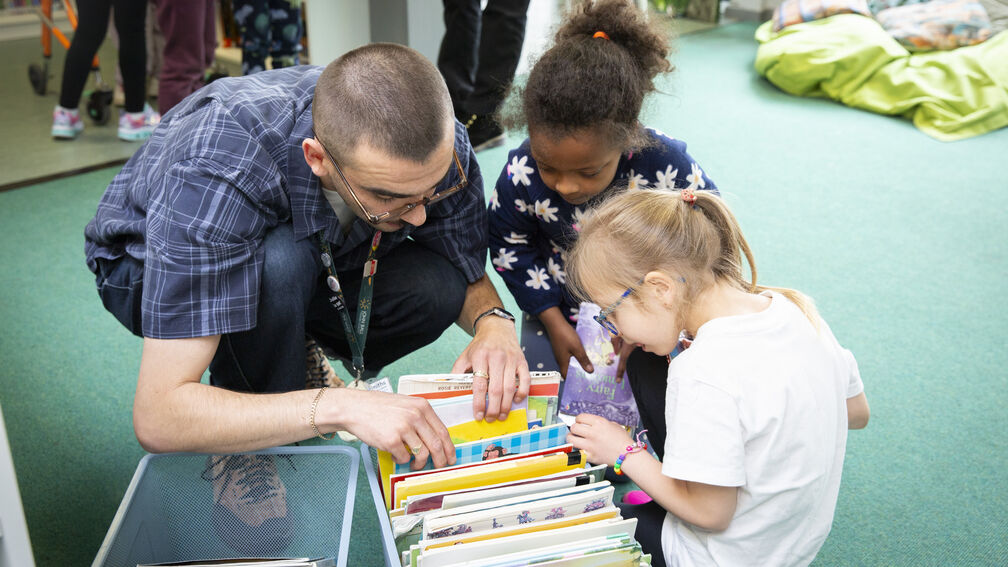
So another way that all teaching staff can help the children they teach is through helping them with their book selection. So while choice is really important, it’s also true that some children might need help and encouragement to find the books that they might enjoy. So just like we mentioned before, you may have children who are obsessed with transport, technology, and engineering.
And you might suggest non-fiction titles and other stories for them. Similarly, you might have children who are a little bit shy, who might be experiencing some issues such as confidence or worries about transitioning to a new year or moving to a new school. And there are books that can help to support them through that journey too.
And similarly, it’s important to help families to come and select the books that they might enjoy too with their children. So, communicate with your teachers, with your colleagues, and with families where appropriate to help suggest the books that you think would benefit their children.
So, the same is also true for the books that you choose to read with children in your settings. We’ve got lots and lots of resources on our site that help you match themes, interests, purposes with the right kind of books.
So, check out our site for lots and lots of the most contemporary and the best quality books that might be suitable for a range of purposes in your setting.
More access to books leads to more meaningful choices.
- Keep a varied and up to date book collection.
- Support children with their reading choices.
- Present books in an accessible, appealing way.
- Use your knowledge of students to help match them up with books they’ll enjoy.
Our Bookfinder resource connects readers with the perfect books.
- Select your chosen age range.
- Select interests and themes.
- Explore our recommendations.
You can also encourage families to use the Bookfinder tool to find books that suit their children’s interests.
Book talk and discussion
Emma highlights the importance of discussion and modelling when encouraging children with their reading.
One of the most meaningful ways that practitioners can be reading role models is to read children’s books themselves.
If you have good knowledge of children’s books, then you can recommend them to the children that you work with and you can support them in making those choices themselves independently as they become more confident in themselves as a reader and they learn to know what they enjoy and what they don’t.
You can also pay attention to what the children are already reading in your class or the children that you work with and maybe pick up one of those books and read it yourself. You don’t have to love it. You don’t have to enjoy it, but you need to open those conversations with a child as if you love it as much as they do.
Talk to them about what’s happened in the book. Ask them, have they got to the bit with the duck yet? What did they think of it? You thought it was really funny. They’ll be really excited that you’re actually reading the same book as them and it can also make them feel validated in their reading choices.
It shows also that books are a social experience. Reading is something that can help you to connect with other people. It’s not just something that you do on your own in silence.
Representation
Emma speaks about the importance of children seeing their lives and experiences represented in books.
Books play an important role as windows and mirrors for children. These stories can affect the way that they see themselves in the world around them and the way that they interact with one another. It’s important for all children to see different experiences and different backgrounds represented in books so that they can be all feel equally valued.
It’s important for all children to see themselves in books. It can be particularly important for those children who do not see themselves as readers or don’t think that books are for them. Coming across a character in a book who they can identify with, who looks like them, who has a shared experience with them can make them feel like books actually are for them and that they could be a reader, too.
Meeting an author or an illustrator who shares the background of a child who perhaps doesn’t enjoy reading or doesn’t think of themselves as a reader can be a really great way for them to re-engage with books and to realize that actually books aren’t just for one type of person. They’re for everybody.
As a practitioner, you can make a conscious effort to seek out books that represent the children that you work with so they can see themselves and their classmates in the books that they have access to at school. This is why we’re so passionate about Book Trust represents virtual visits. We get the opportunity to show children all across the country that there’s not just one type of person who creates books and there’s not just one type of person who is a reader. Books are for everybody.
It is important that children see their experiences, backgrounds and identities represented in the books they read or have read to them.
Positive representation helps children see themselves as valued readers and affects their relationships and reading motivations.
Books with diverse representation also help to build community by offering windows into the lives and experiences of other children.
View this as a presentation
1 McGeown, S.P. and Wilkinson, K., (2021). Reading motivation and engagement: Research, theory and practice. London: Routledge.
2 The role of multiple ‘reading influencers’ in supporting children’s reading journeys – BookTrust
Contributors
George Lewins works on producing book content for BookTrust, including creating resources for families and educators. He has previous experience as a primary school teacher.

Emma Zipfel is a member of the books team at BookTrust, responsible for our BookTrust Represents programme and project managing authors and illustrators. Before joining the team, she worked for many years as a secondary school English teacher.
Optional assignment: book audit
Put your learning to the test by completing this optional assignment.
Provide feedback
Access more professional development support resources
Find out when the next resources will be released
Our primary school or early years newsletters will notify you when the next resources are released to help support your professional development. They will also give you the latest information on activities and resources you can use to support reading with babies and children.
Sign up now-
Here are 100 books from 2026–27 that we think are great – and so will children
-
Search thousands of hand-picked book recommendations to find a child’s next favourite read – from astonishing adventures to fantastic facts, our Bookfinder tool will help you discover the very best kids’ books