Making the jump from being read to, to reading for yourself can be quite a scary one. My youngest daughter loved stories. She adored being read to and had a brilliant memory for characters and lines of dialogue but really struggled to make the switch from picture books to early readers and beyond.
Like many children, my daughter couldn’t quite make the connection between the letters on the page and the things she needed to say out loud. Every sentence was an effort, and it was disheartening to see her working so hard to decode every word. As an English teacher I was keenly aware that if she lost enthusiasm for reading at this early stage, she would continue to struggle throughout her school years, and I was anxious to stop that happening.
One of the biggest problems we faced was that my daughter was embarrassed by the ‘babyish’ books she was still reading at school. She would carry around books I knew she couldn’t read because she wanted to fit in with her friends who all seemed (to her) to have easily picked up reading while she continued to struggle. We tried all sorts of things to help her, and one of the most successful was graphic novels. The limited words on a page lifted some of the anxiety she felt at staring at a page filled with text and the pictures gave her a different way to engage with the story. Unfortunately, many of the graphic novels my daughter was able to read didn’t feel like ‘proper’ books to her. We needed to find a book which used clear and simple language but still looked and felt like a young fiction book with chapters, engaging characters, and a developed plot.
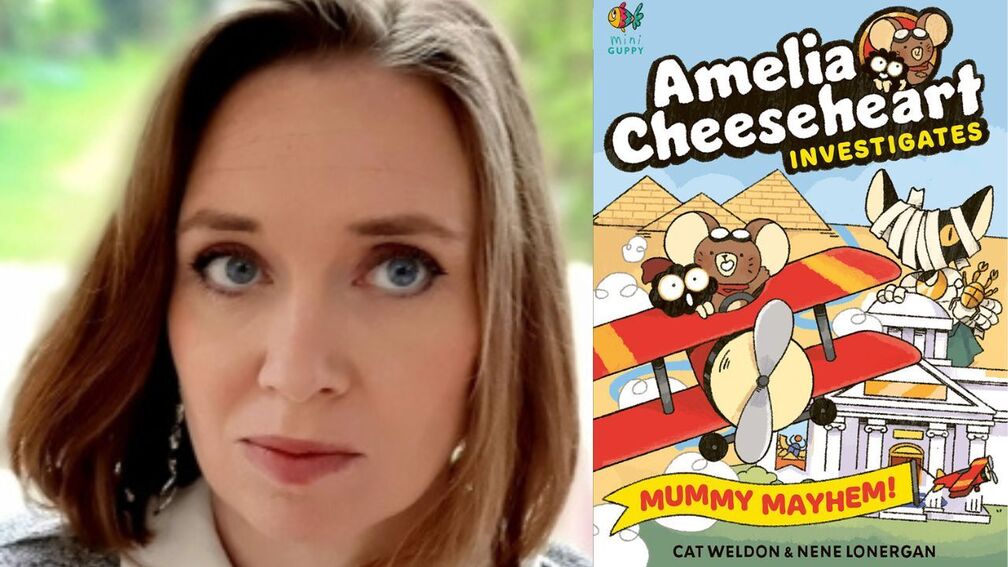
Enter Amelia Cheeseheart, the bravest, boldest and most adventurous mouse in the museum.
I wrote Amelia Cheeseheart Investigates to help my daughter and anyone else struggling to make the shift from picture books to young fiction. Every child develops their reading skills at a different rate, and I firmly believe that it’s up to us as adults to help children find the right books to encourage them to find the joy in reading.
Every child is a reader, sometimes they just need the right books.
Here are some tips we found helpful to develop reading confidence.
- Practise every day. Like any skill, reading needs time to develop. Just don’t make it feel like a punishment – no one wants to read if they have to stop doing something else fun to do it.
- Set manageable limits and stick to them. It can be easier to start if you know you’re going to stop in half a page.
- Read everything. Our world is full of the written word and reading doesn’t have to be limited to novels. Try reading road signs, shop windows, packaging, song lyrics for karaoke, maps, joke books or encyclopaedias of your favourite film franchise.
- Give reading a practical function. Some children find it easier to concentrate on reading when they can see it has a purpose. Recipes or instructions are good for this. Or maybe try drawing a character or location based on their description in a book.
- Put captions or subtitles on when watching something on a screen for some sneaking reading.
- Try word puzzles! Word searches, hang man, crosswords, and codebreaking are all brilliant ways to play around with language.
- Finally, our favourite:
Split up the text and share it. One sentence or paragraph each, or – and graphic novels are perfect for this – read it like a script! Everyone picks a favourite character and reads their lines. Silly voices encouraged!
Amelia Cheeseheart Investigates, written by Cat Weldon and illustrated by Nene Lonergan, is out now.