This resource features author Michael Rosen and focuses on the role reading plays in children’s wellbeing.
Michael Rosen at the Reading Rights Summit
This professional development resource features renowned author Michael Rosen and focuses on the role reading plays in children’s wellbeing; highlighting contemporary research that explores the internal and external wellbeing benefits of reading, and exploring the mechanisms by which reading can influence children’s wellbeing.
Recognise the potential wellbeing effects of reading.
Understand how reading can affect wellbeing.
Appreciate the adult’s role in reading for wellbeing.
Learning objectives
Reading in the curriculum
Reading for pleasure and wellbeing should not be considered secondary to reading for literacy attainment.
Settings have a responsibility to develop a positive reading culture and support children to develop strong reading habits and to read for pleasure.
This is referenced in the National Curriculum, the Reading Framework, the EYFS Statutory Framework and the Ofsted Inspection Handbook.
National curriculum:
“Through reading in particular, pupils have a chance to develop culturally, emotionally, intellectually, socially and spiritually.”
page 13
“Reading also feeds pupils’ imagination and opens up a treasure-house of wonder and joy for curious young minds.”
page 14
Reading framework:
“Pupils who read regularly report heightened levels of social and emotional wellbeing.”
pages 12 & 13
EYFS statutory framework:
“Children should be supported to manage emotions, develop a positive sense of self, set themselves simple goals, have confidence in their own abilities, to persist and wait for what they want and direct attention as necessary.”
page 9
What is wellbeing?
Wellbeing is a broad term that covers many aspects of life, from feeling good and building positive relationships to having a sense of purpose and opportunities for personal growth.
Exploring feelings
Michael Rosen talks about how reading can be an excellent way to explore and understand feelings.
Hi I’m Michael Rosen and I write books and I come around to schools and book festivals doing shows based on my books. Sometimes they’re poems, sometimes they’re stories. When you read a book to start off with, you might be reading it because it’s fun or because it’s exciting, but actually when you’re reading it might also make you feel better and it can make you feel better because it cheers you up.
Or it can make you feel better because there are all sorts of emotions and feelings in a story and you start thinking about them and then if you’re in a state of mind where maybe you’re a bit upset, bit angry, bit lonely you might discover when you read that you’re not on your own you’re a bit like one of the characters in the book.
And once you start thinking I’m a bit like somebody in a book then sometimes that can make you feel better and that’s great.
Enjoyment of reading leads to higher levels of mental wellbeing. [1]
Engaged readers are 3x more likely to experience high mental wellbeing. [2]
Enjoyment of reading early in life leads to better mental health in adolescence and as children grow older. [3]
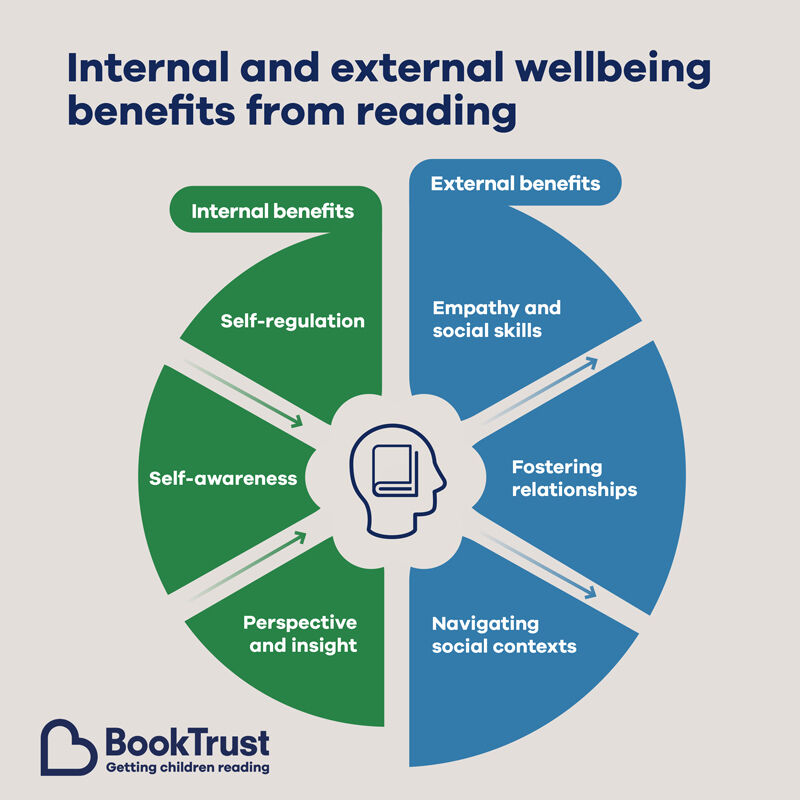
Reading provides internal and external wellbeing benefits
Books are a place you can go
Michael describes books as a safe place you can go to be feel better, gain perspective and interrogate your emotions.
So always remember that books are like a wonderful place you can go to. You can go into the book and if you’ve got feelings like you’re a bit worried or you’re sad or you’re lonely or you feel angry and you don’t know why you’re angry – maybe you’ve got feelings of just not feeling good – you know we call that we got a word for that depression that when you go into a book it can relieve you.
Remember that word I said, relieve, so as you’re in the book you’re away from the things that are bothering you but at the same time it can take you to those places and help you think help you think about those feelings those emotions, so books are a fantastic place to go.
Self regulation – managing behaviours and reactions
Self awareness – recognising and relating to others’ experiences
Perspective and insight - developing empathy and community
Books as stress relief
Michael outlines how books can relieve stress and improve mood.
Now I wonder, did you ever see any of those TV programs about somebody called Professor Branestawm? Well they started out as books and when I was a boy I read those books but something else about when I was a boy when I was 10 and just becoming 11 there was a great big exam and it was like a great big demon in my mind this great big exam that was called the 11 plus.
And if you passed that exam you went to a school that most people wanted to go to and if you failed people were quite worried certainly if when I was 11 they were worried you’d go to a school that wouldn’t be nice. In fact they were okay but that’s what we thought so I’d worry about it. Will I pass that exam? Terribly terribly worried, I’d lie awake at night and I’d go mom mom she’d come up and I’d say I think I’m going to fail the 11 plus cuz I’m no good at arithmetic no good at s she’d say I think you’ll be all right I think you’ll be all right I said can I have a drink she bring me up a milk drink but at the same time when I was having all those worries and believe me they were really big worries my brother was reading to me Professor Branestawm books.
And Professor Branestawm books I thought were the funniest books that I’d ever ever read or ever ever heard someone read to me because Professor Branestawm is very very clever but very very absent minded so he’s kind of clever and not clever. Course I wanted to be clever so I could pass the exam but some or other reading about this clever man who can’t even find his glasses sometimes he’s wearing seven pairs of glasses on his head and he still can’t find his glasses it was what we call a relief it relieved me I could laugh and felt good and then I could think about how just because you’re clever it doesn’t mean that you’ve got common sense.
Reflect:
Which books or reading experiences had an impact on you when you were a child?
What do you remember about these reading experiences?
Did your reading have an impact on your feelings or mindset?
External benefits
Empathy and social skills - connecting and communicating with peers
Fostering relationships - building confidence and lowering stress
Navigating social contexts -connecting feelings to real life experiences
Reading for empathy
Michael outlines how books and reading encourage children to develop empathy and connect with others.
One great thing about books is that when you’re reading them you’re looking at other people’s feelings, how they’re thinking. So in a way it’s almost as if you put their clothes on or you put their shoes on. We’ve got an expression, “in other people’s shoes,” but really you’re in other people’s minds.
There’s a moment in Where the Wild Things Are where what happens in the writing, it says: Max wanted to be where somebody loved him best of all. You know, I read that to my son, he was only three at the time, many many times, and he never said anything. He didn’t say anything at all, we just read the book, we read it over and over again. And then one day after we had read it 30 times, we got to that bit and I said “Max wanted to be where somebody loved him best of all,” and he just went, “Mommy.” I thought, what, where’s that come from?
You know what he was thinking, don’t you. He was thinking, if I was Max and I wanted to be where somebody loved me best of all, I would think I would like to be with my mommy. That’s a great big thought for a three year old, but actually it’s a thought that we all have when we’re watching a film or watching TV, but best of all when reading.
When you’re reading, you’re thinking: if I was that person I would be afraid, or if I was that person I would be angry, or if I was that person I would be lonely, or if I was that person I’d be scared. Any of these feelings — what we do in our mind is say, if I was that person. Now the moment you do that, I’ve got a big word for that: that’s called empathy. Empathy means thinking like another person.
And you know, really, the whole of our lives, if we don’t think how other people think, then we really end up being very selfish and not very nice at all, actually quite nasty. So what we have to do in life is work out how other people think, so that we can all get on. And books help you do that.
Well, thanks very much for watching and enjoy your reading. That’s it from me.
Reflect:
Can you think of a book you have read that has helped you to empathise with another perspective or set of experiences?
Can you think of a social situation that children might experience that could be supported by a relevant book?
Adults’ role in reading for wellbeing
Supporting children to develop positive reading habits is key to unlocking wellbeing benefits.
Read quality books with children
Scaffold pupils’ book choices
Facilitate discussions about books
Reading with children
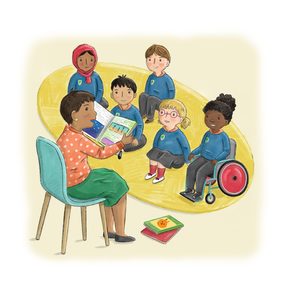
Reading lots of high-quality, diverse books with a mix of styles, genres and themes is the most valuable thing practitioners can do with children.
Whether sharing a book with an individual, reading to a group or listening to a child read, aim to make the experience interactive and collaborative.
Adults can support children to make independent reading choices by talking to them about their interests, showcasing a diverse range of genres and modelling selection processes.
Get to know children’s interests and find books that align with them to drive engagement. Our Bookfinder tool helps find relevant, high-quality books.
Adults play a key role in scaffolding and supporting book choices, helping children explore diverse genres that, in turn, foster various emotional experiences and wellbeing benefits.
Supporting wellbeing as a teaching assistant
Sophie gives practical advice about how practitioners can use books and stories to support children’s wellbeing.
So, as TAs, I think we’re uniquely placed to help children with their um accessing the accessing the resources and extending their learning because teachers have a huge responsibility to be able to get data and record and do more one, you know, group work and one-on-one. I’m as a TA, we’re a bit more free to move around the class and the playground and really engage with those children, ask those open-ended questions, try and really get that knowledge out of them, extend them, really help them to access the resources.
Sometimes I just sit in the book corner for half an hour with the kids and just read and that’s my morning. Sometimes I’ll be on the on the um the art table just painting doing we’re doing butterflies at the moment. And as TAs, I feel like we have that freedom to create those bonds with children, especially if there’s you have a shared interest with the child. Um books, funny stories. At the minute, we’re doing all creatures great and small. And um the children are very engaged with the creatures, the mini beasts and the big beasts.
And so just being able to sit there as a TA and really delve into the book or delve into your non-fiction books on your topic table. Um get real conversations, real sort of meaningful content out of these kids because they want to talk to you. They want to tell you stuff and as a TA I feel that we can really give them the time to sit there and explore these themes.
So in reception there are plenty of opportunities to do storytelling and share stories with children. Um often you’ll have some shy children who aren’t engaging with the resources and the activities. So, I might sit in a book corner with a child and just quietly read a story and sort of elbow them and go, “Have you seen this? Oh my gosh, that’s amazing.” Um, reading stories out loud just on my own and it sort of piques their interest. They come over and I’ll point out things in the book. Um, have you ever experienced this? Do you know what this is? Have you ever felt this way?
On the small well table, we always have um word banks and word cards that are linked to the book like key vocabulary to help extend their learning and expand their vocabulary in their language. So I’ll often go to the small well table and we’ll have props or puppets or masks or toys and act out scenes from the book or just any scene from the book really. Um and just you know talk to the children and say have you ever felt this way? What is this character feeling? Why are they feeling this way?
As TAs, we are um able to spot when those children are finding maybe the morning or the afternoon or those key points in the day that are a bit tricky. And so, as a TA, we can take them out and just sit with them in a nice calm quiet space, take either the cortex or any story because, you know, all reading is is fantastic, is important, and just sit in a calm area out of the classroom. Sometimes maybe in the book corner. Sometimes I’ll go outside if it’s a nice sunny day and just really give them that one-on-one time that those children will need to help get them back to being ready and to regulate them.
Sometimes um the the the craziness of the classroom can be so much and just taking those children who might need a bit of a a little bit of a stroke, a little bit of a lean and just taking that story and creating that bond with them to let know that they’re safe. Because once children realize they are safe, they engage. And that’s what we want from them is to be able to engage with the stories and to be able to vocalize how they’re feeling.
Using your relationships with learners
Recognise when children may need emotional regulation through reading.
Identify social situations where books could help children to process feelings. This might include learning to share or welcoming a new child to the class.
Be a reading role model by talking about books you enjoy and how they make you feel. Use questioning to help children relate books to their experiences.
Key takeaways
Reading provides wellbeing benefits for children:
Internal: Self-regulation | Self-awareness | Perspective and insight
External: Empathy and social skills | Fostering relationships | Navigating social contexts
You can unlock these benefits by reading with children and using books to help them explore their feelings and talk about their own experiences.
Michael Rosen is one of Britain’s best loved writers and performance poets for children and adults. His first degree in English Literature and Language was from Wadham College, Oxford and he went on to study for an MA at the University of Reading and a PhD at the former University of North London, now London Metropolitan.
He is currently Professor of Children’s Literature at Goldsmiths, University of London where he co-devised and teaches critical approaches to reading on an MA in Children’s Literature, having done the same at Birkbeck, University of London. He has taught on MA courses in universities since 1994.
He was the Children’s Laureate from 2007 to 2009 and has published over 200 books for children and adults, including the recent bestseller Many Different Kinds of Love and On The Move.
1 Clark, C., & Picton, I. (2018a). Book ownership, literacy engagement and mental wellbeing. National Literacy Trust.
2 Clark, C. & Teravainen-Goff, A. (2018). Mental wellbeing, reading and writing. National Literacy Trust. Retrieved March 17, 2025, https://nlt.cdn.ngo/media/documents/Mental_ wellbeing_reading_and_writing_2017-18_-_FINAL2_qTxyxvg.pdf.
3 Sun, Y.-J., Sahakian, B. J., Langley, C., Yang, A., Jiang, Y., Kang, J., Zhao, X., Li, C., Cheng, W., & Feng, J. (2024). Early initiated childhood reading for pleasure: associations with better cognitive performance, mental well-being and brain structure in young adolescence. Psychological Medicine, 54, 359–373.
Assignment
Put your learning to the test by completing this optional assignment:
Our primary school or early years newsletters will notify you when the next resources are released to help support your professional development. They will also give you the latest information on activities and resources you can use to support reading with babies and children.
Find out how reading can bring wellbeing benefits for children with our new guide, compiled with support from children’s mental health charity Place2Be.