Featuring demonstrations and advice from author and speech and language therapist Lucy Rowland, the module offers practical strategies to help teaching assistants support children’s early communication, vocabulary and expressive language skills through reading.
Reading for speech and language development: free CPD training module for primary teaching assistants
This resource focuses on reading and its role in speech and language development in the early years and Key Stage 1.
Learning objectives
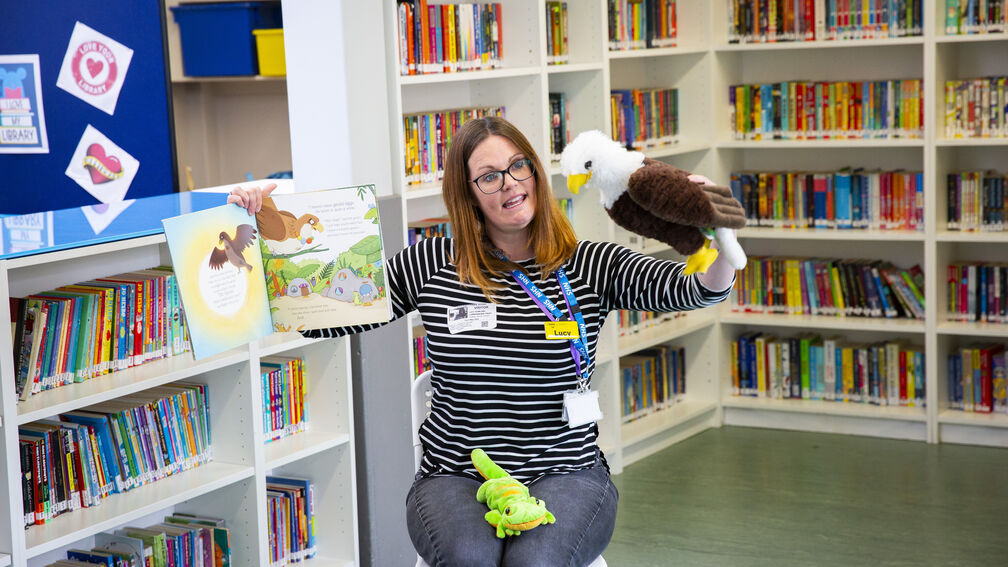
This professional development resource features author and speech and language therapist Lucy Rowland and focuses on the role reading plays in speech and language development.
- Understand the role of reading in speech and language development
- Recognise teaching techniques and features of books that can be used to support speech and language development specifically
Reading in the curriculum
National curriculum
“Pupils’ acquisition and command of vocabulary are key to their learning and progress across the whole curriculum. Teachers should therefore develop vocabulary actively.”
page 11
“Teachers should develop pupils’ spoken language, reading, writing and vocabulary as integral aspects of the teaching of every subject.”
page 10
EYFS statutory framework
“Reading frequently to children, and engaging them actively in stories, non-fiction, rhymes and poems, and then providing them with extensive opportunities to use and embed new words in a range of contexts, will give children the opportunity to thrive.”
page 9
Reading framework
“The guidance discusses the importance of talk and stories, and the critical links between these, especially the role stories play in developing young children’s vocabulary and language. It also considers the role of poetry, rhymes and songs in attuning young children to the sounds of language.”
page 6
“More generally, sharing and discussing pictures in non-fiction books offers opportunities to broaden children’s experiences beyond the immediate and the local. For example, books about space, other countries, animals, exploration, and courageous people from a range of occupations and ethnic backgrounds are rich sources of vocabulary and knowledge.”
page 25
Ofsted school inspection handbook
“When evaluating early reading against the ‘quality of education’ judgement, inspectors will consider whether: stories, poems, rhymes and non-fiction are chosen for reading to develop pupils’ vocabulary, language comprehension and love of reading.”
paragraph 277
“Teaching is a broad term that covers the many different ways in which adults help young children learn. It includes their interactions with children during planned and child-initiated play and activities, communicating and modelling language, showing, explaining, demonstrating, exploring ideas, encouraging, questioning, recalling, providing a narrative for what they are doing, facilitating and setting challenges.”
paragraph 454
Speech and language development
Speech and language is made up of:
Receptive (internal)
- Listening and attention
- Sound recognition
- Understanding vocabulary
- Comprehension
- Recall
- Inference
Expressive (external)
- Sound formation
- Expressing wants and needs
- Selecting relevant vocabulary
- Organising thoughts
- Observing social cues
- Reasoning
Reading and language development
Participating in reading experiences supports children to:
- Understand the structures of language
- Become phonologically aware
- Improve their self-confidence
- Develop a wide vocabulary
- Create connections
- Build relationships
Features of books and stories
In the next section, children’s author and speech and language therapist Lucy Rowland will demonstrate some of the key features of books that can support children’s language development.
Hi, my name is Lucy Roland and I am a children’s speech and language therapist and also a children’s picture book author.
So with repetition, it’s really nice if vocabulary is repeated in stories because we know that children learn words best when they hear them lots of times. So, it’s also really nice for children to have that opportunity to repeat the words themselves and join in with the story because then they have the opportunity to have a go at using those words as well as hearing them lots and understanding them.
With rhyme, I think um if we think about sort of simple nursery rhymes and repetitive songs, those are some of the first um language learning steps for children and uh toddlers. And something about that rhyme and that repetition really supports children to remember and retain new words. Um, and then as they approach preschool age, they start to think about the sounds in words and the similarities and the differences. So again, rhyme with its really repetitive, exaggerated rhythms really supports those early funological awareness skills and those are the skills that are really important when children start school because they support things like reading and writing and spelling.
All of a sudden, the tree branches shook. Can you see anything up here? A smell. Oh, it does look a bit like a snake. Shall we see if you’re right? That’s a good guess. I wonder… it was not a snake this time. What was it? Oh man, a tiger. A tiger’s tail. What? And way up above him, Jack saw something jump. A tiger arrived on his branch with a thump. Can we all say thump? Thump. Bumpy thump.
Repetition
“Repetition is also a great way of encouraging engagement.”
Books that feature repeated words or refrains help children internalise the meaning of new words in context.
They also increase familiarity and confidence with the spoken sounds of the words or phrases in the story which can then be applied in new contexts.
Rhyme
“Rhyme and repetition improve the retention of new language.”
Rhyme helps children recognise the varied sounds in language and to notice similarities in words they encounter.
Rhyming books add rhythm, tone, meter and anticipation to stories, making them memorable and demonstrating the joys of books and language.
Chorusing
So chorusing is when a group of people all join in with telling parts of the story together. And it’s really nice for children um for their fluency and their sort of confidence in telling parts of the story. But it also really supports engagement in stories because if you know that there’s a section coming up where we’re all joining in, you might be more likely to be listening to the rest of the story really, really well because those parts are really fun and they’re really exciting.
Wriggle and slide. But this trees just for me. Jack weighed the snake.
Chorusing is an opportunity for everyone to join in with a repeated refrain, in the form of a known word, phrase, sentence or passage.
It supports children’s fluency as they practise and repeat, helps to build their confidence as they enjoy the communal aspect of chorusing, and boosts engagement as children anticipate the chorused refrain so that they can take part.
Questioning while reading
Lucy explains how questioning can help children to apply new vocabulary and language structures.
Questioning can really support language development and it’s really good for trying out new vocabulary because you are then giving the children opportunities to use those new words that they’ve just heard in the story um in their own answers. But also using open questions uh is a really nice technique to use because children give slightly more detailed answers and that supports with their sort of organization of language and organization of thoughts and their reasoning skills.
So you can start with quite simple questions that are very concrete. So questions like who or what. So, who’s this or what’s that in the picture? And then move to slightly more abstract questions like when or where questions. And finally, moving on to those slightly more complex questions like why or how is that character feeling or oh, I wonder what might happen next. And those are lovely questions because they rely on things like inference and prediction and um reasoning.
But she was also really brave. Her tail was long and flicky. She stood on four short legs. And day and night she guarded her little gecko. Eggs. Eggs.
Questioning gives children a structured opportunity to apply newly learned vocabulary in relevant contexts.
Asking questions supports children in organising their thoughts so that they can be expressed effectively. Questions can range in complexity to suit needs.
Blank’s Levels of Questioning outlines different orders of complexity and gives examples of the kinds of questions you could ask .[1]
Experiencing a range of stories
Lucy explains how exposing children to a range of books provides a rich variety of vocabulary and language structures.
Sharing a diverse range of books exposes children to a rich variety of vocabulary and language structures.
Knowing pupils’ interests and ability will help you select appropriate books and boost engagement.
Different texts will have different emphases in terms of language skills development, so consider your choices.
Preparing for reading activities
Lucy explains some practical steps practitioners can take to prepare for high-quality reading experiences.
It’s really important that children have a whole range of books and stories to develop their language because books are such fantastic language learning devices and they are full of really rich vocabulary and it’s vocabulary that we might not in our day-to-day interactions use with children. So things like soaring dragons and sparkling lagoons or fierce pirates. So they’re hearing lovely rich vocabulary. So of course if you um read on a whole range of topics then you are exposing children to lots of different types of words, different topic vocabulary, and this is fiction books and non-fiction books, but that breadth of reading is really important to expose them to as many new words as possible and they will then start to understand those words and then use them in their own expressive language.
I think it’s about um knowing the children that you are reading to. So knowing the group that you’re working with and choosing books where the language structures and the words aren’t too complex um but there is still that element of novelty or challenge. So you’re exposing them to some new words or new structures. Um some children have difficulties with their attention and listening skills. Choosing a book with lots of opportunities for um interaction and active participation.
There are some lovely books out there. Uh there are books like Tom Fletcher and Greg Abbott’s book. There’s a monster in this book or there’s a dragon in this book. There’s a whole series that really encourage children to physically interact with the book by tapping the pages or um tilting the pages of the book using their voices and using actions to engage with the story. And there is the phenomenal YouTube series by um Pipper Goodart and Nick Sheret where that is fantastic for encouraging discussion um and choice making with children.
There are also books where uh you have to look for a character on a busy spread and books where you have to um listen to a story, listen to a sentence and understand that sentence and then find the right character from a choice of characters. So that’s kind of working on receptive language or understanding of language.
Of course, there are stories which have repeated refrains, and these are fantastic for children to join in very confidently with because they’re very predictable and very safe. So, the wonderful um We’re Going on a Bear Hunt. I think that’s one of the reasons it’s such a classic and such a favorite. Um, it’s got such repeated language in and children really know quite quickly how to join in with that.
Read books before sharing aloud and consider opportunities for:
- Asking questions which extend or check comprehension.
- Discussing the meaning of a new word or phrase.
- Pausing to allow children to complete a sentence.
- Encouraging chorusing and repetition.
- Making connections to other stories.
- Inviting actions or role-play.
Managing behaviour
Lucy shares her approach for maintaining control of a group during a story session.
I think that getting that balance right is really tricky. You want it to be fun and and but not too over the top and and raucous. So, um sometimes just your normal kind of clapping patterns that you use in classroom to gain attention back or wiggling fingers in the air, waiting for everybody to be a little bit quiet and then carrying on with the story.
Um, also things like those those techniques to support active engagement in the stories can be a really good opportunity just to say, “Oh, everybody’s back with me.” So things like repeating a word, things like doing an action as a group, and then suddenly you’ve got them all back together again. Um, sometimes I build movement breaks into my story sessions. So, if they’ve listened um to a story and I know we’re going to have another story later, I might get the all the children up and moving and a real active movement break. But these can get really raucous. Um so, it’s quite nice to sort of end that game with a a much quieter type instruction. And I think you saw in my session today with um with using the the toys uh and we were shouting gecko really loudly, but at the end we then did five whispers and everybody was very calm at the end again.
The snake is slithering along, slithering along, slithering along. And she he wants to get those eggs again. He and I had kids. But you scared him away after the game. Should we play after the game? Okay. Ready? Who was next? Do you remember who was next to you? Eagle. She’s circling up high in the sky and she spotted those eggs. Uh-oh. She wants them for her lunch. She’s coming in. She’s coming down to get them. And oh, wow. And we see everyone.
Who was last? Then he wanted the rat. The rat is scuttling along and quickly coming in and scuttling and scurrying and scuttling and scurrying. He wants to get the eggs out. He scared my gecko away as well. Oh no, you scared gecko away. It was so loud. So this time we’re going to whisper five times and see if we can get Gecko back. Are you ready? But we’re going to just scare you away. There you go.
Too much active engagement and excitement can risk disrupting the learning benefits of your reading sessions. It’s a fine balance.
Along with your normal behavioural practices, try to redirect over excitement or disruption using the techniques you have seen so far.
Try encouraging the repetition of a phrase, asking a question, instigating an action or movement break, or adapting the volume or tone of your voice to bring your audience back to being focused.
Key Takeaways
Reading contributes to the development of both receptive and expressive speech and language development by…
- Introducing vocabulary.
- Demonstrating language structures.
- Increasing phonological awareness.
- Facilitating comprehension through discussion.
- Improving confidence and fostering connections.
View this as a presentation
Contributor

Lucy Rowland is a picture book author and children’s speech and language therapist with a real passion for sharing the joys of stories and language with young children.
Assignment
Choose five books that contribute towards different aspects of speech and language development from each of the following categories:
- A book with rhyming text.
- A story with a repeated refrain.
- A book that requires choice and interactivity.
- A non-fiction text that will introduce vocabulary.
- A story that will inspire questioning and discussion.
Read these books over a week to a group and record your reflections.
Provide feedback
Access more development support resources
Find out when the next resources will be released
Our primary school or early years newsletters will notify you when the next resources are released to help support your professional development. They will also give you the latest information on activities and resources you can use to support reading with babies and children.
Sign up now-
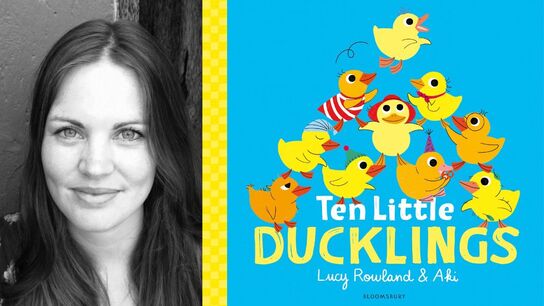
Author and Speech and Language Therapist Lucy Rowland describes why reading with children is so important in helping them learn language.
-
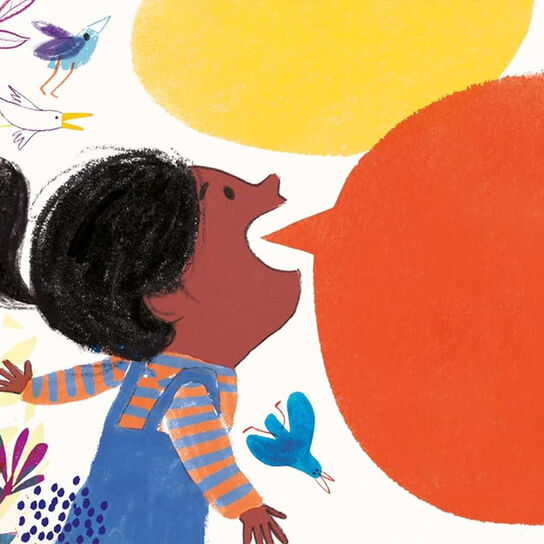
Introducing children to language in a fun way