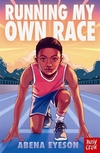
Author Abena Eyeson shares how stories can help children work through disagreements and conflict in their own lives.
Image: Bex Glendining
Abena Eyeson
In my novel Running My Own Race, one of the ideas I explore is handling conflict.
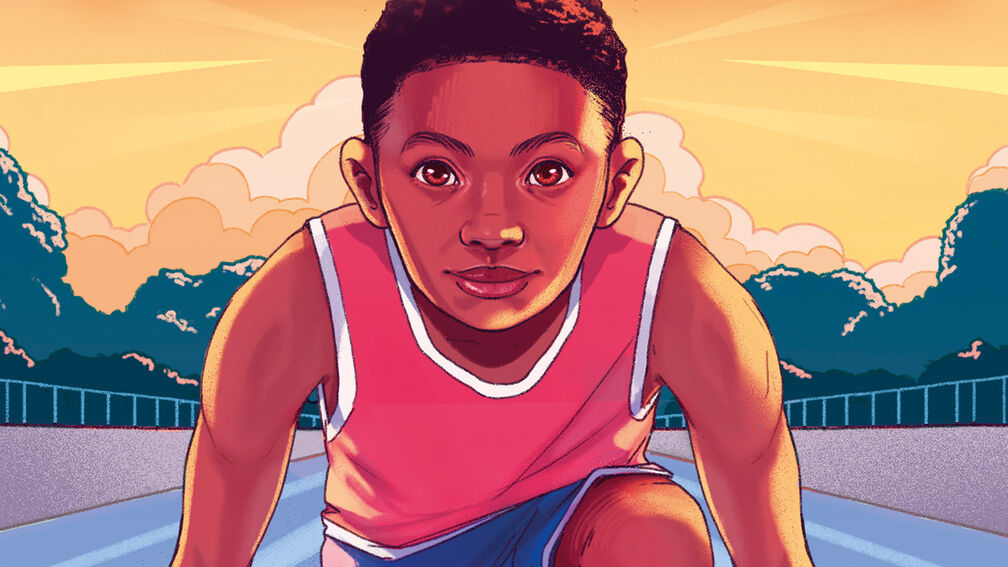
The story is about 11-year-old Kofi, who, after getting a scholarship to a top private school, has to overcome many struggles as he pursues his dream of becoming a professional sprinter. One of the challenges he has to deal with is Miles, a rival on the athletics track at his new school. He bullies Kofi to try and stop him from outshining him.
Towards the end of the story, to show a way in which conflict can be resolved healthily, there is a “restorative justice” meeting between the two boys, supervised by their athletics coach. Kofi gets to tell his truth directly to Miles, who takes ownership of the harm he has caused. This approach of working through conflict was informed by my previous experience.
The power of mediation
Before I became a children’s author, I trained as an internal workplace mediator during my career in HR. Mediation is a way to mend relationships after a disagreement and for the parties involved to come up with shared solutions for the way forward.
Through my work, I have seen that it is possible for people in conflict to find a way through mediation to work together constructively, even if they don’t necessarily become friends.
When I was writing Running My Own Race, I wanted to highlight that children have the capacity to learn and develop and bullies can change their behaviour. It struck me that mediation might be a way to do that, even for children, and this led me to the restorative justice idea I used in the novel.
Using restorative justice in schools
Restorative justice is known in the criminal justice system for allowing the victim and offender to communicate in a controlled space where they speak about the harm that has been done and explore ways to repair that harm.
Adopting a restorative approach to resolving conflict in schools will have the same focus – repairing harm as opposed to just punishment. It will encourage a change in behaviour by getting the child to focus on their action, to understand the impact of it on others, and to take responsibility for their behaviour.
It also gives the child who has been harmed a chance to speak their truth in a controlled environment. The restorative approach encourages the development of empathy and understanding.
Conflict and disagreement will inevitably be present in every child’s life and it’s important that they learn from an early age how to work through such situations in a healthy and constructive way.
Demonstrating a positive approach to conflict resolution in books for children can provide them with concrete examples of how these skills might be used in their own lives. My hope with Running My Own Race is that by seeing Miles face up to what he has done and Kofi speak his truth to him using the principles of restorative justice, young readers will see the benefits of healthy conflict resolution and will try it out in real life.
More books to try
Alongside my book, here are some examples of other books for children that will not only entertain readers, but also model healthy conflict resolution.
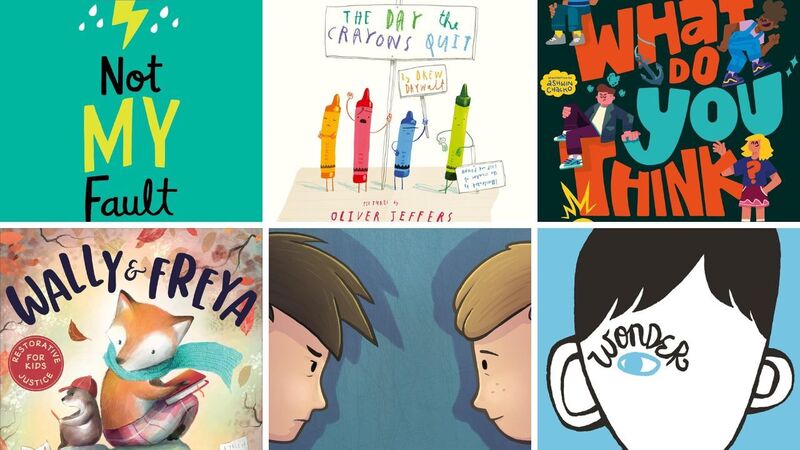
Not My Fault by Cath Howe
A brilliant and realistic depiction of conflict between siblings, where one of them blames the other for a life-changing injury.
Told in a dual-narrative format between the two sisters, they spend the entire book in conflict until a pivotal event has them speak their truths to each other and approach their conflict from a place of empathy. An inspiring book about forgiveness.
The Day the Crayons Quit by Drew Daywalt, illustrated by Oliver Jeffers
A humorous picture book, but instructive nonetheless! A great depiction of how conflict and disagreement can be resolved through communication, being open to someone else’s perspective, and being understanding of the needs of others.
Award-winning illustrator and artist Oliver Jeffers has teamed up with film writer and director Drew Daywalt to create this gorgeously colourful picture book.
What Do You Think? by Matthew Syed
This illustrated non-fiction book for children explains how to disagree with someone but still be respectful and empathetic. It’s written in an engaging and humorous style which makes it a light read, but impactful.
Wally & Freya by Lindsey Pointer and Stella Mongodi
This heartwarming picture book, recommended by the European Forum for Restorative Justice, is a story about Wally, who has a reputation for being a bully.
He does something which causes a lot of upset and Freya helps him to understand the impact of his actions on others. They find a positive way to make things right from then on. The book shows the importance of empathy and a restorative approach in resolving conflicts.
What Are You Staring At? A Comic About Restorative Justice in Schools by Pete Wallis and Joseph Wilkins
This graphic novel explains to children the restorative approach to resolving conflict and shows how it can be applied in school.
After a misunderstanding between Jake and Ryan leads to a fight at school, both children are left feeling angry and worried about what will happen when they next see each other. Their teacher arranges a meeting to allow the boys to talk and understand each other’s point of view. This turns their feelings of anger and worry into positive ones. The illustrations in the book help to make it an easy read.
Wonder by R.J. Palacio
A powerful and uplifting story about 10-year-old August Pullman, who is born with syndromes that result in him having severe facial deformities. At 10 years old, after being previously home-schooled, he starts school and has to deal with the challenge of other people’s reactions to him.
When he overhears Jack, who he thought was his friend, say mean things about him, he feels betrayed. He stops being friends with Jack. Their friendship only starts to mend when Jack apologises to August, takes ownership of what he has done and answering August’s questions honestly. An inspiring story that has been turned into a film.
August (‘Auggie’) Pullman can’t help but stand out – he was born with a severe facial deformity. Written in the first person, Wonder follows Auggie as he experiences more than the usual ups-and-downs of friendships, family and school.
Kofi earns a scholarship to a prestigious private school and must overcome bullying and academic pressures to achieve his dream of becoming a professional athlete. A moving and important story.