Featuring professional storyteller Chip Colquhoun, the module offers practical techniques and advise to help teaching assistants deliver engaging, purposeful shared reading experiences.
Engaging storytelling: free CPD training module for primary teaching assistants
This resource focuses on the features of engaging storytelling and reading aloud in the early years and Key Stage 1.

Learning objectives
This professional development support resource focuses on some of the key features of engaging storytelling and reading aloud.
- Recognise features of engaging storytelling and reading aloud.
- Understand and incorporate features of engaging storytelling and reading aloud into your own practice.
National curriculum
“Pupils should be taught to: develop pleasure in reading, motivation to read, vocabulary and understanding by: becoming increasingly familiar with and retelling a wider range of stories, fairy stories and traditional tales.”
page 21
“Pupils should continue to have opportunities to listen frequently to stories, poems, non-fiction and other writing.”
page 37
EYFS statutory framework
“Literacy ELG: Comprehension – Children at the expected level of development will: Demonstrate understanding of what has been read to them by retelling stories and narratives using their own words and recently introduced vocabulary.” “Anticipate – where appropriate – key events in stories. Use and understand recently introduced vocabulary during discussions about stories, non-fiction, rhymes and poems and during role-play.”
pages 13 & 14
Reading framework
“Teachers are the best people to promote a love of reading because children, particularly young children, care what their teachers think about the stories they read aloud. If teachers show they love the story, the children are likely to respond in the same way. However, this does not mean that teachers should choose only the books they loved as children.”
page 31
Ofsted school inspection handbook
“Inspectors will consider, taking into account any exemptions from the learning and development requirements of the EYFS, how well: staff develop children’s love of reading through reading aloud and telling stories and rhymes.”
paragraph 452
Features of engaging storytelling
In this training resource, author, storyteller and founder of Epic Tales Chip Colquhoun will break down and explain some of the features of engaging storytelling.
Choice and voice in storytelling
Chip outlines some of the key features of engaging storytelling for children.
If you do like a bit of performance and you do like doing the voices, why not actually build that into the conversation and actually ask your listeners, what sort of voice should I use for this particular character? That way, again, the focus comes more on their engagement with the story rather than their engagement with you and your performing ability.
And in fact, you could you could do that even if you’re not great with voices because I bet if you ask that question to your listeners, they will help you craft a voice that will be wonderful.
You can begin the engagement with your listeners even before you start with the story by having them help you to choose the story. So, one of the methods that you can use very similar to the method that I used where you essentially get each of your audience to lean in the direction of the sort of story that they might like so that you can kind of see the mood that they’re in for the sort of stories that they like.
This direction is going to be for a story full of danger. Okay. So, if you want, go that way. If you want danger, go that way. Off you go. That way.
So, well, lean lean your body lean your body in the in the way. So, you folks are wanting funny. Oh, you got quite a few people who are feeling dangerous today. Okay. All right. All right. I’m getting an idea. I’m getting an idea of the story that you like.
It all comes down to knowing your listeners and seeing what mood they are in at the time and letting that help guide you to the story that you’re going to tell.
Having said that, if there is a particular story that you want to be telling, you can still get a level of engagement before you dive into those stories by talking about the picture on the book, asking for what they can see, exciting their curiosity so that they actually have that burning desire for the book to be opened up and to go into it.
Being given choices is the first way we learn how to define ourselves.
Sarah Coyle, author of the Pick a Story series
This element of choice can also be applied to shared or group reading experiences.
Children are more likely to be motivated if they feel involved in the reading session.
Children can be encouraged to:
- Help choose stories or books based on their mood/interests.
- Participate by choosing actions to accompany a story.
- Help to craft characters’ voices with the adult reader.
- Offer their opinions about stories they have read.
- Decide characters’ actions in interactive stories.
Reading as a conversation
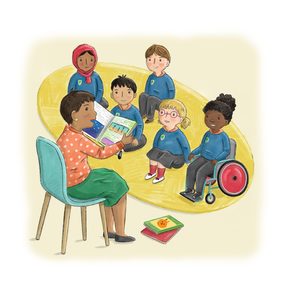
Chip talks about the importance of involving the audience in reading experiences, rather than just performing to them.
If you look really carefully, what you’ll see that we’re doing is we’re just having a conversation with the listeners. I was asking questions to do with the story that we were telling.
That is the number one thing to remember when you are sharing stories. Whether it is uh from memory like I do or or from a book. If you keep your listeners focused on the story by just checking their enjoyment, actually talking with them about the story, that’s going to be the thing that keeps them engaged all the way through in the churchyard. Yeah.
It’s if if it’s if it’s it’s his finger. What? Like like from an actual person. Yeah. That was the sort of thing that Johnny was thinking as well. And he looked down at his own body, which was a skeleton.
And he looked in particular at his leg. Do do any of you know how many bones you’ve got in your leg, not including the foot. Do you want to have a guess? How many bones have you see if you can count them? See if you can feel feel the bones in your leg. See if you can feel. How many do you think you’ve got in your leg? Two. Two. You reckon you’ve got two? Yeah. Is that what you’re reckoning as well? Or you got think you got more?
So rather than thinking of it like a performance, definitely think about it like a conversation.
Children are eager to share their thoughts and opinions and to feel involved in reading experiences.
By asking questions and responding to feedback you will maintain engagement, encourage deeper comprehension and support language development.
Dialogic reading strengthens children’s executive function, early learning, and attention by improving the quality of adult scaffolding. [1, 2]
- Ask open-ended questions about books that allow for creative responses.
- Expand on responses by introducing new vocabulary or information.
- Encourage children to connect stories with their experiences.
- Differentiate and scaffold questioning to suit different needs.
- Allow time for children to talk to their peers about the book.
Engaging an audience
Chip shares practical advice on encouraging and maintaining children’s engagement during reading experiences.
We often uh think in situations where we’re reading that uh any kind of disruptive behaviour is a sign of disengagement. But actually it’s completely the opposite. I can tell you as a storyteller who has been performing for almost two decades. If you have someone in a group of listeners who turns and starts talking to the person next to them or or calling out or making any kind of sound, 99 times out of 10, it will have something to do with the story.
Meanwhile, back at the house, the aunt and the uncle, they had their tall glasses of fears and they were just about to go check when there was ready a knock at the door.
It’s the boy. But they were really angry. They didn’t like people coming to the door. They went over, they yanked open the door, and every how did you know it was the boy?
So, if you try to get them to shush or pay more attention to you, what you’re essentially doing there is you’re saying, “Uh, please stop engaging with the story, which I’m pretty sure is not what people would want want to be doing.”
But the great thing is if you have that disruptive behaviour, you can actually use it to your advantage because you know that they are engaging with the story. You know, you’ve got the license to actually talk to them and say, “Yeah, absolutely. Shall we find out? Shall we go on?”
You need to have an awareness of your listeners. If you know you have got listeners who are particularly interested in drawing, why not ask them to illustrate the story while you’re reading it? If you have listeners who, you know, like playing with Lego, maybe allow them to play with Lego and see if they can um build the story as you are going along with it.
If you’ve got particularly active listeners, maybe in approach them to be the characters or give them some actions to do something everybody can join in with will be a great way of keeping everyone engaged.
Children may demonstrate their engagement in different ways when participating in a story.
Calling out, fidgeting, talking or not looking at adults may appear disruptive, but these behaviours can be signs that children are excited, thoughtful or engaged.
Try to harness the energy of your audience and channel it into engagement.
Engagement can be supported by encouraging participation in the reading experience.
Practitioners should:
- Use actions, movements, echoing and chorusing to engage audiences.
- Be aware of individuals’ needs and build in ways for them to engage.
- Allow all children to see illustrations if reading from a picture book.
- Try to redirect disruptive behaviour into constructive engagement.
- Demonstrate active participation when listening to others read.
Book talk and discussion
So I think a lot of the time in schools reading for pleasure time is seen as own choice reading, own choice independent reading and that is a valuable thing. But really a far more valuable use of those 15 minutes is to have book discussion time.
Allow everyone in the class to be chatting with each other and with you about the stories that they’ve really enjoyed lately. that is going to really heighten their interest in reading so much more and give them more avenues to explore by listening to what each other are enjoying.
So talk with your teachers, maybe see if you can run a kind of little book club session like that every so often. Make reading for pleasure time.
Children are more likely to develop positive reading habits when they see their peers and role models exchanging ideas about reading. [3]
This is a valuable aspect of reading and should be actively encouraged by providing resources, adult support and dedicated time for discussion. [4]
Practitioners should:
- Talk about your own reading with children and adults to model discussion.
- Scaffold meaningful discussion with extra resources like sentence starters, prompts or pictorial aids.
- Model discursive language about the books or stories you read aloud
- Encourage peer to peer discussion and recommendations.
Key takeaways
Build in elements of choice into story selection and reading experiences.
Reading aloud should be a dialogue with listeners, not a performance.
Keep children engaged by involving them in the reading experience.
Encourage book talk and discussion about books and reading.
View this as a presentation
1 Murray, L., Cooper, P., Koopowitz, S., Maré, K. and Stein, A. (2023) ‘Effects of training parents in dialogic book-sharing: The Early-Years Provision in Children’s Centres (EPICC) study’, Early Childhood Research Quarterly, 62, pp. 1–16. https://doi.org/10.1016/j.ecresq.2022.07.008
2 Twait, E., Farah, R., Shamir, N. and Horowitz-Kraus, T. (2019) ‘Dialogic reading vs screen exposure intervention is related to increased cognitive control in preschool-age children’, Acta Paediatrica, 108(11), pp. 1993–2000. https://doi.org/10.1111/apa.14841
3 Cremin, T., Hendry, H., Rodriguez-Leon, L., & Hulston, S. J. (2024). Informal book talk: digging beneath the surface. Education 3–13, 52(7), 930–945. https://doi.org/10.1080/03004279.2024.2357882
4 https://ourfp.org/finding/rfpp/booktalk-and-recommendations/
Contributors
Chip Colquhoun is an author, storyteller, musician, teacher trainer and developmental editor. He is the founder and lead storyteller at Epic Tales. Chip has been working with children all around the world since 2007, helping them discover the magic of stories.
Assignment
Put your learning to the test by completing this assignment.
Share a book or story with a group of children with a focus on the following:
- Build in an element of choice in your story or book selection.
- Aim to make your reading session a dialogue with your audience.
- Think about accessibility and engagement, can you adapt provision to engage all children? For example, allowing a child to illustrate the story.
- Start a discussion about the story before, during and after reading.
Record your reflections on the levels of engagement from your audience.
Provide feedback
Access more development support resources
Find out when the next resources will be released
Our primary school or early years newsletters will notify you when the next modules are released to help support your professional development. They will also give you the latest information on activities and resources you can use to support reading with babies and children.
Sign up now