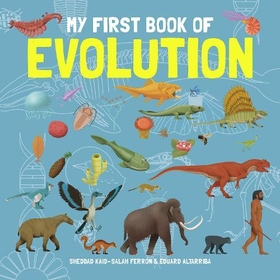
My First Book of Evolution
by Sheddad Kaid-Salah Ferron, illustrated by Eduard Altarriba
Interest age: 9 to 11
Reading age: 8 to 9
Published by Button Books, 2024
About this book
All life adapts to its surroundings. Fish use their gills to breathe underwater, and are the ideal shape for moving through it. The desert cactus can store large amounts of water to withstand long periods of drought. Evolution means that something changes and transforms over time to suit its environment and be able to thrive within it.
Featuring chapters on natural selection, Charles Darwin, heredity, genetic variability and speciation, this is quite a deep dive on the subject of evolution. Altarriba’s illustrations are gorgeous and their vibrant, graphic style, with plenty of diagrams and helpful layouts, help to make the material more digestible.
Ferron and Altarriba take the reader through Darwin’s original theory and then look at how evolution has been influenced by human intervention in artificial selection, using the example of animal breeding. They also look ahead to the future of humanity and what influence technology might have on our bodies, minds and lives, over the next thousands of years.
As with the other books in this series, there is some rather advanced information contained in My First Book of Evolution, despite the fact that it’s a picture book - meaning that it is best suited to older primary aged children.
More books like this
-
Evolution: Join us on an exhilarating journey from the origins of life to the present day!
by Sarah Darwin and Eva-Maria Sadowski, illustrated by Olga Baumert
9 to 14 years
-
My First Book of Microbes
by Sheddad Kaid-Salah Ferron, illustrated by Eduard Altarriba
5 to 14 years
-
A History of Fashion for Children
by Celia Joicey and Dennis Nothdruft, illustrated by Rose Blake
7 to 14 years
-
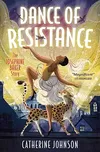
Dance of Resistance
by Catherine Johnson, illustrated by Katie Hickey
9 to 14 years
Lists of recommended reads
-
Books about biodiversity
Biodiversity refers to the variety of life on Earth in all its forms, and there are many. From miniscule bacteria to colossal blue whales or from tiny flowers to giant redwoods, every living thing on our planet has its own unique role in the global ecosystem.