Author Loris Owen shares the power of not knowing straight away
Loris Owen
I’ve often wondered why riddles run so deep through our literary and cultural bedrock – from Tolkien’s riddles in the dark in The Hobbit, to Carroll’s playful logic and famously unsolvable Mad Hatter’s riddle in Alice in Wonderland, from Elgar’s puzzling musical motifs to the existential code-breaking of Bletchley Park.
Riddles are found almost universally across the globe, from the Yoruba to the Inuit. Yet there’s no denying that the language of our green and pleasant land is a uniquely fertile ground for wordplay.
Riddles and their roots
English has absorbed over a million words over the millennia, drawing from Latin, French, Germanic tongues, and more. One study estimates that borrowed loanwords now make up around 80 per cent of our vocabulary.
These multicultural roots give us a rich palette of synonyms, homophones and double meanings, essential tools for lenticular punchlines. Shifts between nouns, verbs and adjectives are made easier by the addition of prefixes and suffixes, by compounding and blending. The special malleability of our language lends itself beautifully to riddles, where surprise definitions and hidden meanings hide in plain sight.
Early riddlers are plentiful and well documented, their work much debated. As far back as the seventh century the hundred riddles of Saint Aldhelm pay tribute to Creation in snowballing stanzas of Latin verse. Anglo-Saxon scholar Alcuin travelled from York to the court of Charlemagne in the eighth century to teach, advise and write, crafting a series of ‘Problems to Sharpen the Young’. The late 10th-century Exeter Book, which includes around 95 Old English riddles, has beengranted UNESCO status as one of the world’s ‘principal cultural artefacts’.
And then there’s Shakespeare. Aside from conundrums such as the casket in The Merchant of Venice, and the witches’ cryptic prophecy in Macbeth, the Bard’s language was often a riddle in itself: our much-loved neologist coined thousands of new words by twisting and reassembling existing ones, often for rhetorical, comedic, or, naturally, foolish effect.
Thinking sideways
I owe much to riddles. I was 15 when my dad taught me sideways thinking – in particular, the tricks and building blocks of cryptic crosswords – and I’ve been hooked ever since. Those Friday afternoons together, passing the paper back and forth, shaped me. It was more than just being clever: it was together time, hunting for gold.
I’ve yet to visit a classroom where children don’t delight in this kind of treasure hunting. They stand on the mental shoulders of giants, lips moving silently as they think quietly to themselves; they reach for the sky, arm straining towards the just-within-grasp answer. Their guesses might be wrong, but each one has extraordinary value, flexing neural circuits, building confidence and persistence. As the philosopher John Locke once wisely observed, ‘the great art of learning is to understand but a little at a time.’
Studies demonstrate that riddles enhance children’s linguistic awareness: they stealthily lead us to reflect on language itself, not just meaning. Reading comprehension, memory and cognitive flexibility are strengthened as we juggle multiple possibilities.
The psychologist’s lens suggests that riddles serve human needs beyond intellect: they give us emotional resilience, social trust and shared discovery. To embrace uncertainty in a good puzzle encourages safe failure and collective fun, bonding communities around curiosity and celebrating a journey toward sustained learning. If, as Joan Didion wrote, we tell ourselves stories in order to live, then perhaps we tell ourselves riddles in order to grow.
Riddles in contemporary children’s books
The ancient power is very much alive in contemporary British children’s novels, whose authors have stitched riddles painstakingly into the wordcraft of their plots. There are many wonderful examples, and I’ve chosen just a few of my favourites here.
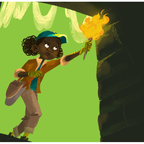
Wonderscape (Jennifer Bell) draws readers into an otherworldly quest where riddles unlock each new level via a new virtual character from history. Escape Room and its sequel Race to the Escape (Christopher Edge) trap characters in high-stakes puzzles that test problem-solving and courage.
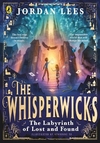
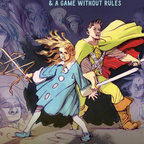
A Riddle for a King (Mark Forsyth) places wordplay at its core, each new conundrum a fork in the narrative path that requires some serious cerebral cog-whirring and impishly teaches the logic agility of history’s greatest minds. The Whisperwicks: The Labyrinth of Lost and Found (Jordan Lees) follows Benjamiah into the dreamy realm of Wreathenwold, where candlelit lanterns whisper cryptic messages.
Reclaiming attention in a digital world
American scholar Herbert A. Simon warned that ‘a wealth of information creates a poverty of attention.’ We are all digital citizens of that world now, in which answers come with a tap and gratification is instant. The slow and very human pleasure of discovery risks being lost.
But riddles can disrupt that constant cascade of chimes and clicks that wear down the brain – the promise of more and more, bigger and better, but ultimately hollow dopamine hits. By nurturing interactive play between author and reader, books with riddles compete with digital lures, rewarding patience and slow thought over instant scroll. Riddles charge a fee of patience, insist we linger in uncertainty and resist the urge to cheat. And that lingering is where the real magic happens.
Our four nations have a proud heritage of mind-play and mystery and I remain hopeful that these timeworn traditions will continue to enrich our lives. The greatest joy is often the journey toward the answer, not the answer itself. Like Ulysses, we go forth ‘to strive, to seek, to find, and not to yield.’
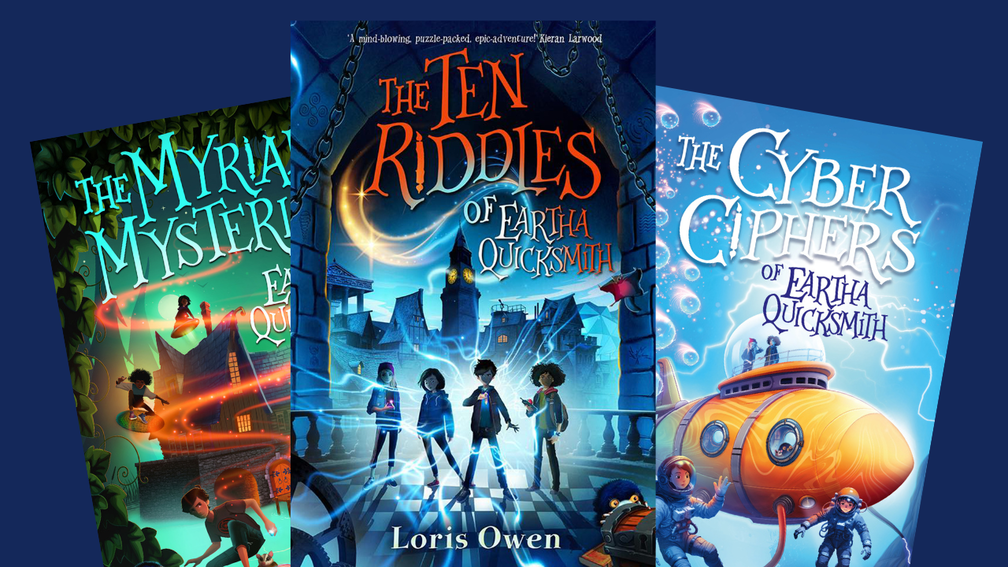
The Quicksmiths trilogy by Loris Owen is out now.
Read our reviews of some of the books listed by Loris
Three friends slip through a time portal and find themselves thrown 400 years into the future, trapped in a complex virtual reality video game world called Wonderscape… but how will they find their way out?
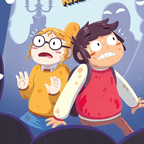
Twelve year old Ami can’t wait to get started when she arrives at The Escape Room – she loves puzzles, riddles, and all things brain-bending! But the stakes for this particular game are sky-high… can she and her teammates get out in time?
When Philo discovers a strange new world through a secret door in the grandfather clock, he embarks on an utterly bonkers, magical adventure, which is beyond his wildest dreams.
In this haunting fantasy adventure, a parallel world is ruled by a terrible monster and citizens are controlled by fear and a legion of masked Hanged Men.
Does your teenager yearn for adventures? Do they love their films and video games chock-full of swashbuckling and quests? Then here are some books guaranteed to entertain.
From an ape getting involved in a murder case to schoolgirl cat burglars and mysteries taking place across the world, there are some brilliant capers out there just waiting to be devoured.