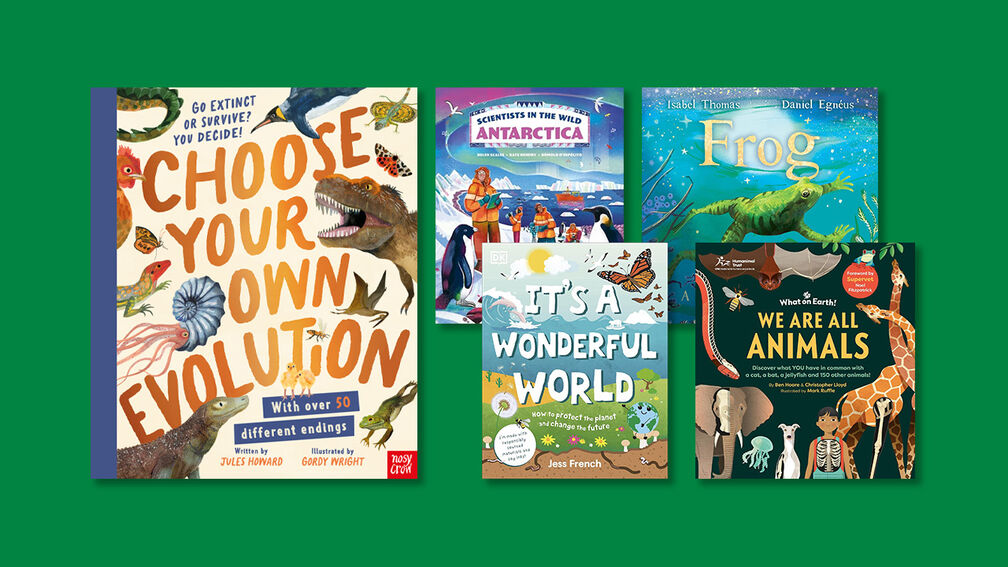
Author Jules Howard shares why children’s books about animals are needed and recommends some fascinating non-fiction reads.
Jules Howard
When I visit a school or I’m lucky enough to do a signing in a bookshop, there are some questions from children that come up again and again and others that don’t.
This article focuses on the questions that don’t, or rather, one question in particular: ‘What got you into animals?’ which is a classic of the adult question genre that is (and has been) asked to zoology writers the world over for decades.
I don’t think a single child has ever asked me the question ‘What got you into animals?’ and for one simple reason. It’s because nearly all children innately seem to understand that animals are deeply interesting, therefore the question serves no purpose. It’s like asking someone ‘What got you into breathing air?’
To children, in my experience at least, it’s obvious why animals are worth studying, researching and/or writing about. It’s because they do things. They interact. They have faces that you can read. They can be dangerous, clever, unpredictable, wily, smart, cute, and jaw-droppingly peculiar. Other things in daily life don’t tend to be like that.
And so, to children, animals are inherently interesting. The innate interest that children seem to exhibit for fellow life forms has a name: it’s called ‘biophilia’.
The power of connecting books and animals
If you’ve ever walked into a bookshop or visited a primary school library, you’ll be bowled over by evidence of biophilia. There are whole bookshelves devoted to animals, so hungry are children to connect with and understand the complicated others of this planet.
In one Netherlands study, which investigated 217 award-winning children’s books, a staggering 97% of books featured one or more animals and 79% of books had animals as essential characters.
Even insects (abhorred unfairly by many adults) feature in about 10% of children’s books.
I see biophilia and children’s books as a very encouraging and fortunate combination.
In a world of increasing environmental uncertainty, where extinctions continue apace, it seems to me that animals offer us a unique opportunity to talk to a young and very receptive audience that is eager to consider the future of our planet in a way that isn’t scary, doom-mongering or gloomy. Environmentally, this type of engagement should really be our priority.
Non-fiction books to try
There are some fantastic non-fiction books out there that tenderly introduce young people to nature, wildlife conservation, and saving our planetin a very accessible and go-get-’emkind of way that doesn’t fill readers with fear.
Great examples of these are Jess French’s bright and bouncy It’s a Wonderful World and Helen Scales’ Scientists in the Wild series, with Kate Hendry and illustrator Rômolo D’Hipólito. These are books that pitch scientists as real people, solving complex and often very exciting questions in a changing world.
There are other non-fiction animal books that have widened this message, using the science of zoology and the natural interest in animals that exists in children to explore deeper scientific, even philosophical, themes.
Two recent examples of these are Isabel Thomas’ gorgeously illustrated FROG: A Story of Life on Earth (art by Daniel Egnéus), which delves into the convoluted history of life on our planet through the lens of an innocent child asking a simple question about a backyard frog.
And there’s Christopher Lloyd and Ben Hoare’s We Are All Animals (illustrated by Mark Ruffle), which reminds readers (parents and teachers included) that life is a family tree, a tangle of diverging descendants with bodies made from tweak-upon-tweaks, layered through animal generations.
In both books, humans are one story among many. An important part, granted. Stewards, really. But connected to all life.
by Ben Hoare and Christopher Lloyd, illustrated by Mark Ruffle
2025 9 to 14 years
Non-fiction
Picture books
This fascinating book reminds us that we humans have many things in common with animals; we have far more in common than we have separating us.
Keeping the love of animals going
In recent years, I have tried to widen some of the animal themes in my own children’s non-fiction books in a bid to encourage young people to think more broadly about the human story and our modern role as planetary protectors.
That was one of the aims of Choose Your Own Evolution(illustrated by Gordy Wright), where one ‘ending’ of the book sees readers take on the form of a human child who is reading a non-fiction animal book, considering what kind of life they might want to lead knowing the series of unfortunate extinction events that had to occur to provide the ecological space for humanity to evolve. Too deep? Personally, I don’t think so. We’ll see, I guess.
Biophilia may turn out to be a happy evolutionary accident. An open goal through which we can generate more nature-smart adults via the medium of animal-related books, read by families and teachers. If this is true, it’s encouraging to see publishers and authors using this space so well.
We’ve got work to do, of course. Some ideas will wash well with children, others won’t. But it’s encouraging to see what’s out there and that, in this space at least, very few of us are standing still.
In children, the natural appetite for animals is likely to be ever-present. We don’t have to sell gloomy messages about death and destruction; instead, it’s about natural enthusiasm for Earthly life.
We have to keep spreading seeds, nurturing the shoots, making the most of the rich seam that biophilia, a natural interest in animals, has opened up to us all. I think we’re doing it well. Perhaps there’s space for more?
Starting as a simple organism in the ocean, you must select your own evolutionary pathway and avoid extinction. A brilliantly fun, interactive non-fiction book.
Children love discovering the animals and plants that live close by – whether it’s a tree on a pavement, a duck in the local park or flowers in someone’s garden. There is so much to spot when you’re out and about! Here’s a selection of books to inspire little nature lovers.