Author and screenwriter David Farr advocates for fiction based on real people in history.
David Farr
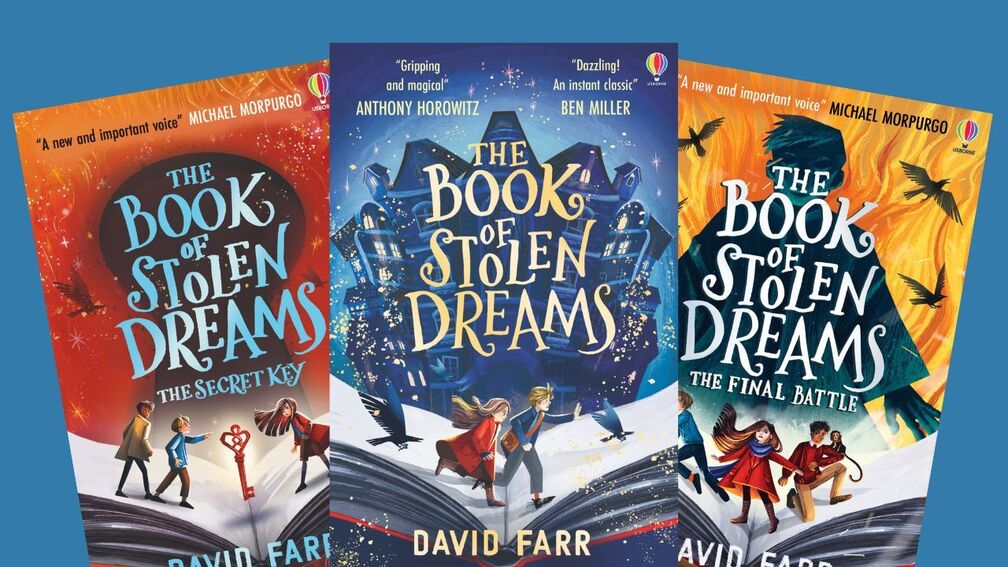
The Book of Stolen Dreams is my trilogy of books for middle-grade readers. They take place in a fictional world, ruled by a vicious despot, Charles Malstain.
A brother and sister, Robert and Rachel Klein, are entrusted with a very special book by their father, shortly before he is imprisoned by Charles Malstain’s authorities. Together, Robert and Rachel embark on a roller-coaster adventure to discover the magical secrets of the book and why Charles Malstain wants it so much.
Making connections
When I go into schools to talk about my trilogy, I start with a reading. Rachel Klein is on an airship fleeing her country. I quiz the kids on details from the opening chapter. Rachel is in disguise, she has a secret message in her sock, a man is interrogating her on the freezing deck of the airship. Is he trustworthy?
Then I show them a real photograph. It’s a black and white photograph of three children posing for the camera in old-fashioned clothes. I simply ask, “Who are they?” Then, over a ten-minute period, the kids guess. And they always eventually get to the answer. “The three children are your ancestors, your granny and her siblings, they lived in Nazi Germany, they fled Hitler, and they are the inspiration for your book.”
Once we’ve got there, we can go deep. The young readers start to make connections. We talk about arrests without charge, concentration camps, trains to terrifying locations, we talk about European antisemitism.
But we also talk about refugees now, asylum seekers fleeing terror in today’s world. We make comparisons and contrasts. We talk about tyranny. What is a despot? What is dictatorship? Is it something only in the past, with a Swastika? Or is there dictatorship in our world right now, on our TV screens, and online?
An imaginative approach to history
What interests me every time I give these talks is how fiction makes the conversations about facts more alive. By starting with something invented, it’s as if the young people’s brains are already in a creative and imaginative space, rather than thinking, “Oh, here come the facts we have to learn.” And this allows for a more creative relationship with the actual history.
I’ve had remarkable offerings when talking about my dictator Charles Malstain’s propaganda machine in the fictional country of Krasnia. One child suggested that Hitler and Henry Ford were really just two sides of the same coin. This led to an interesting discussion about what propaganda is and whether anything we hear on the news can be trusted.
Of course, children’s fiction can be directly historical. Michael Morpurgo is probably the master of this and I always remember reading Eva Ibbotson’s The Dragonfly Pool and feeling how intensely personal her story of escape from Nazi Germany was. More recently I read The City of Stolen Magic, by Nazneen Ahmed Pathak, and was personally enlightened by the stories of Bangladeshi integration into East London in the early 20th century.
But I think that sometimes fantasy or magical fiction, a story that plays with the ideas of history but in an entirely invented space, can do something unique. It frees the mind from the realm of facts, history, linearity, and allows for a play of ideas and impressions. And more than that, I think it can make history more vivid.
Relating to history through the personal
Because the country in my trilogy is invented, I think kids feel inspired to imagine their own version of city streets patrolled by terrifying soldiers, air balloons fleeing scary shores, heroic young resistance fighters, tall palace gates, and interrogation chambers hidden deep in the earth.
By imagining these spaces, children are effectively considering their real possibility. Both in the past, and in the future. History becomes a living thing. And therefore both more pertinent and more exciting.
And there’s also the human element. History takes place as much in normal streets as it does in palaces and political chambers. In my books, Rachel and Robert’s apartment is the prism through which we see so much of the bigger historical drama acted out. It is firstly a joyful family home, then a secret place of dissent and danger, then it’s invaded by soldiers, searched, brutalised. Finally harmony is restored. We all relate to history through the personal.
I hope that my fantasy trilogy opens young minds to these ideas and impressions. And makes history breathe as an act not of obedient recollection, but collective imagination. Because by imagining the world afresh, we can more easily change it for the better.
A tense and exciting fantasy thriller set against the backdrop of a cruel dictatorship. Complex, magical and packed with great characters – both heroic and evil.
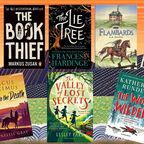
Older children and teenagers will enjoy these compelling stories set in times past – from exciting adventures to thought-provoking tales of troubled times. With a range of periods, locations and themes there is something here for everyone.