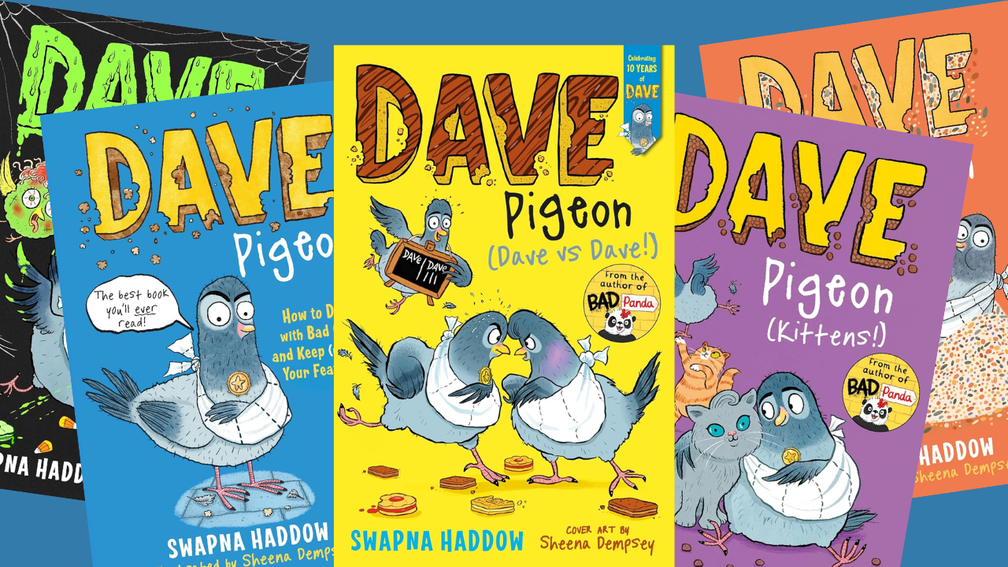
From The Bad Guys to Bunny vs. Monkey – wacky animal stories will always be a hit with young readers. Every time I go to sit at my desk, without fail, a boisterous animal character pops into my head and fifteen books later, I have a bunch of series under my belt featuring a pigeon called Dave, a badly behaved panda called Lin and my latest, The Terrible Trio starring Zeb the zebra, Barry the lemur and Marge the penguin.
But what is it about animals and humour that make the two an irresistible combination for both the reader and the writer? Animals are universally relatable. Every child, no matter the colour of their skin, where they are in the world, their family set-up, or their social background, can relate to a bear or a cat or a pigeon who just wants a jammy biscuit.
That’s because animals can do something magical – they can transcend social and racial barriers in a way human characters often cannot. And when that happens, emotional connections between the reader and the character form quickly, drawing them into the story and on to many more books.
Stretching the imagination
As a writer, working with animals means I can push my imagination to any place I want. The human world has rules (and I’m not particularly good at following rules). Instead, working with animals, I can have my characters break into Buckingham Palace or go for a midnight jaunt and I don’t need to think for a second about where the parents are, whether there is security, or if it’s a school night or not.
I can dive straight into the action and create bonkers scenarios that don’t need a health and safety review. And it is a complete delight to watch young readers do the same and stretch their imaginations to all possibilities, having read an animal adventure book that gives them permission to do so.
I think funny books can often be mistaken for easy or lazy writing and that humour doesn’t have the scope to connect on a deeper emotional level, but this is far from true. Often, funny books with animal characters provide a safe space to look at tricky topics like grief and relationship breakdowns. And writers know exactly what they are doing when they use humour as a tool to explore emotion.
It’s a delicate balance of funny and dark. And when it is done right, you are able to draw a reader in whilst still providing them with some emotional distance by using animal characters. In this way, the reader can explore complex feelings in a space that doesn’t feel threatening or confronting.
Dave Pigeon
I have spent the last decade writing everything from picture books to middle-grade historical fiction to non-fiction to graphic novels, and I know there is a space for all types of books on the shelves – young readers are owed a wide range of brilliant books with an even wider range of awesome characters.
But one thing I have discovered is if you want the most brilliant of fans who write the most creative of letters and fan fiction – you can’t go wrong with a barmy series about a pigeon called Dave.
It has been an absolute joy to see how children relate to the mischief and friendship, love and heroism and everything in between, that the Dave Pigeon series has been all about. It amazes me how relatable a pigeon is and how these books have given young readers the space to explore a wide range of emotions, and to (pigeon) step into the lives of a diverse cast of characters and develop empathy towards one another in a shared reading environment. That’s the magic of wacky animal stories.
Dave Pigeon! (Dave vs Dave) by Swapna Haddow, illustrated by Sheena Dempsey, is out now.
Explore books on a similar topic…
-
From bottoms and pants to kung-fu pandas and monsters, there is a story for every child in this great list of funny books that will have you and your child rolling about with laughter.
-
Patrice Lawrence recommends her favourite reads that make you laugh, as well as shed light on a tough topic.
-
Author Olivia Wakeford recommends some brilliant stories about the amazing bond between animal and child.
-
Author Becca Rogers recommends her favourite fiction starring quirky animal friends