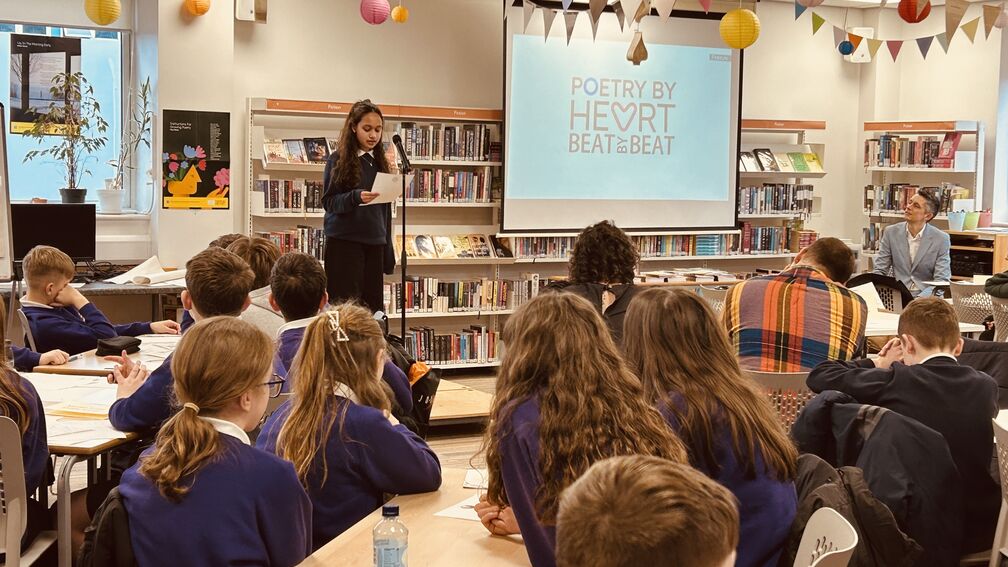
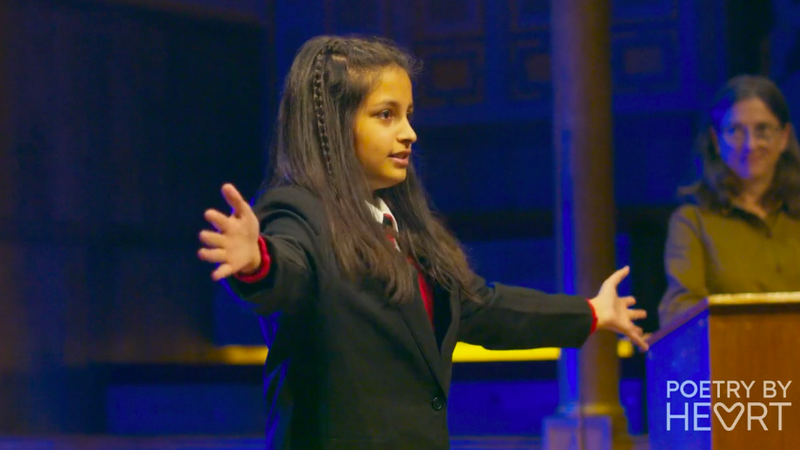
Dr Julie Blake, co-director and co-founder of Poetry By Heart, the national poetry speaking competition, dares pupils to learn a poem
Dr Julie Blake is the Co-founder and Director of Poetry By Heart
Learning poetry by heart has a checkered history. In the 19th century poetry recitation was part of the mainstream literacy curriculum, and it became associated with empty rote learning. In the first half of the 20th century, learning poetry by heart in this way became regarded as something unpleasant. Poet Andrew Motion recalls that he first learned to recite poetry in detention at school, as a punishment…
Yet some years later, as Poet Laureate, Andrew’s aim was to get poetry off the page and into the voice, the breath and the ears of its audience, as demonstrated in his work to start the Poetry Archive, a bank of recordings of significant poets reading their work aloud, and then the national poetry speaking competition we called Poetry By Heart.
“The poems we learn when we’re young stay with us for the rest of our lives … They become personal and invaluable, and what’s more they are free gifts – there for the taking.”
Andrew Motion
Many other poets promote the benefits of hearing and speaking poetry. Ted Hughes wrote frequently to the Secretary of State for Education at the time, arguing for its inclusion in what was to become the National Curriculum. The Nobel Laureate and poet Kamau Brathwaite has described the way that poetry, as part of our oral culture, requires both speakers and listeners for meaning to be made – without both, it cannot come alive.
Now, people are increasingly aware of the benefits of learning poetry by heart, and of listening to it aloud. The schools we work with usually start with a small group of children in an after school or lunchtime club, and then when they see the pleasure that the young people get out of it, and when they realise the deep learning that is taking place, often those schools transform their approach to poetry, creatively finding curriculum space for it despite the pressure of tests and exams.
Learning a poem by heart is the best way to understand it. Often at school, we give young people a poem and expect them to respond immediately. But taking time with it, rereading it, saying it over and over again until you have it by heart means that you’re getting to know it as if you are getting to know a friend. As you read it and listen to it and hear yourself speak it, you begin to settle into it and you start to notice more. Even very simple activities with a class, getting them to learn a poem through call and response, will enable them to say something more meaningful about the poem because of what they’re noticing in it.
The poet Don Paterson says that half of what poetic techniques are doing is mnemonic, that poetry is about memory, because a poem is trying to hold on to a thought, a moment or an experience, and it needs to make that memorable, because otherwise it won’t pass between poet and reader. That idea can get lost in education, if learning abstract terms from glossaries dominates. But by learning a poem by heart, you begin to see how a rhyme becomes a little handhold, that the rhythm helps you to feel the shape of the poem; how the pattern or sequencing of images works like a sort of step ladder through the poem.
Then there’s the confidence that develops from learning poetry by heart – self-confidence, the belief that you can learn something, greater confidence with poetry, and the confidence to speak in front of other people. Learning a poem by heart is also a fantastic form of independent learning, because no one else can possibly learn it for you. It’s not easy to learn a poem, it’s difficult in fact, but that’s not a reason not to do it. By sticking with it and overcoming the obstacles, the reward is very powerful learning. And I know from experience over the last 13 years of Poetry By Heart, that the more you do it, the easier it gets! We have lots of advice on the website about ways of learning a poem and young people tell us that using multiple strategies works best.
Learning a poem by heart is a challenge and a dare, and it’s serious fun. So here’s a dare – for schools and individuals: here are two poems you could learn by heart. First is ‘He Wishes for the Cloths of Heaven’ by W.B. Yeats. This is a really beautiful poem, it’s short, it’s very memorable. And when you speak it, you’re saying something that really matters. And my second choice is ‘maggie and milly and molly and may’ by E.E. Cummings. Because of its sing-song rhythm and its sunny setting, you begin thinking it’s one thing, but once you’ve spoken it a few times, you’ll start noticing the other, darker layers in the poem. It shows you how we can keep coming to a poem and finding new meanings.
Have a go and enjoy some serious fun.
Co-founder and Director, Poetry By Heart
Dr Julie Blake co-founded Poetry By Heart, the national schools’ poetry speaking competition, in 2012. She has been Director of the programme ever since. She is Co-founder and Co-director of The Full English (Education) Ltd, an artisan enterprise to re-resource English for the digital age.
Blake is a researcher and writer about poetry in education and the history of poetry for children. She also creates digital and print anthologies of poems for children and young people.
She is a Visiting Fellow of Manchester Metropolitan University and a contributor to the collaborative PhD Making the Case: What does poetry do for young people?, an ambitious project, funded by the North West Collaborative Doctoral Training Partnership, which has the potential to influence policy and create change across the literature sector. Julie was awarded an MBE in 2025 for services to Education.