Michael Rosen's advice for encouraging your children to read
Every month during his tenure as BookTrust’s Writer in Residence, Michael Rosen answered your burning questions about encouraging strong reading habits in children. We’ve collected all his advice here.
Reading with babies and toddlers
Isn’t it better to wait until they can appreciate the story a bit more?
From the day a baby is born, they are soaking up the sounds, sights, smells, tastes and touch of the world around them. We say that learning how to speak and think are ‘natural’ but we should think of it more that these things are learned by the child because they are in an interesting world. Learning how to talk, and how to talk well, need a lot input from chatty, loving, interested people. There are lots of ways of doing this but the great thing about books is that gives the child something to focus on, to ask questions about, to tell us things about. What’s more, a picture book asks of a child to do a lot of brain work (in a very pleasurable way) figuring out the different ways the pictures and the words they hear us read tell a story. There is a kind of mind-relay that goes on in the child’s mind, relaying from picture to words and back again, figuring out what refers to what, who is what and why.
The simplest thing to do is the oldest: we can sit with a child on our lap. The child looks at the book as we read the story out loud over the child’s shoulder! This gives the child the full experience of the book as their book, while we, the adult, become a kind of ‘voice over’. At the same time, the child has all the reassurance of being on the adult’s lap.
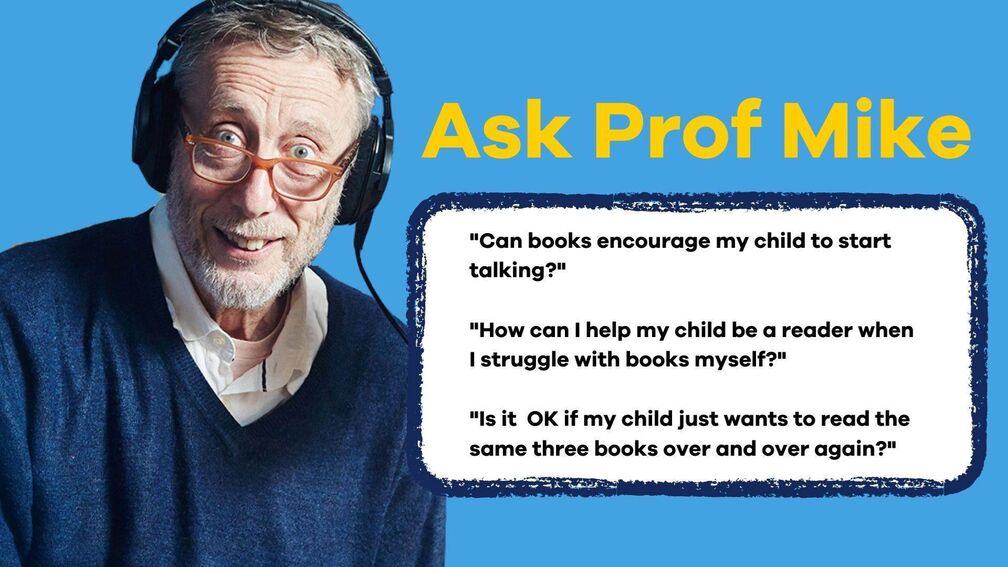
Give him time to explore the pages with you. A good book is likely to provoke him into asking questions or saying things. If not, just try ‘noticing’ things yourself as you go along: ‘Ooh look at that lion! It’s got a hat on!’ That sort of thing ‘models’ how we can make comments about books as we go along.
Just let her go and go on reading out loud to show that you’re really interested in the book.
It depends what they’re made of. I bought board books, cloth books and plastic ‘bath’ books for my children. It makes them more long-lasting than a normal paperback!
Reading with older children
They’re different ages and it’s hard to involve them all at once.
Ah! That’s a hard one. You can try the democratic principle! They each choose their story (or part of a story) IN TURNS!
No. Picture books often have quite deep meanings that become more and more clear as children get older. They might start to see that they are often full of ‘symbols’ – that the story represents something bigger than itself. Also there is great comfort in reading books that are ‘easy’. There is no virtue in books being hard. Reading should be for fun not as bad-tasting medicine.
I’m worried I might do teach them the wrong thing.
No. The more books that you read with your child before they start school, the better. It doesn’t matter if you get it wrong. You can change the words too. You can tell the story from the point of view of a different character. Take my Bear Hunt book, for example. Why not tell the story one time from the point of view of the dog? Pretend to be the dog!
Tips for reading aloud
You don’t have to read every word. Actually you don’t have to read any words. You can make up stories together, looking at the pictures. Most picture books for young children have enough stories in the pictures for you to create little stories as you go along. Remember you can say ‘I wonder if…’ and make up stories about what you wonder might happen just out of sight of what’s actually in the picture.
YES! Each time a child hears the same story they are making new discoveries. Some of these are discoveries IN the book, bits they hadn’t noticed before. Other discoveries are discovering the strange mystery of how the story stays the same even though life in between the last time the child heard the book, has changed. Another discovery is in the area of whether the emotion you had last time can or will happen again – the joke, the scary moment or whatever. This is, if you like, the way we learn how stories work.
Finally, the great thing about ‘doing’ a book over and over again, is that the child learns the book off by heart. This is also very valuable from a language learning point of view: the child learns the tricks and voices of what is called ‘standard English’ – the language of books, newspapers, education, government and administration. All that may seem to be a long way off from the book they’re reading, but actually it’s a huge first step into the language of whole sentences.
This is where you can practise doing voices. Remember: words on the page can be read with different volume (loud or quiet), more or less sing-song, in different accents, at different speeds. You can add a huskiness to your voice. You can pretend to be people on the TV or other people in the family. You can add things like lisps, or nasal qualities or whatever. You could say, ‘who am I today?’ and pretend to be Grandad – or whoever.
No, no, no! They are trained actors. We can read the book in any way we want. I would say that it’s a good idea to read them slowly and clearly. That’s my only tip. As you get confident, you might want to try out a few voices, but I can tell you my children used to tell me NOT to do voices!
Advice about libraries
YES. You must. Just walk in and ask one of the librarians how to join and they’ll tell you. It’s simple, easy and you’ll have access to 100s of books straightaway and look out for events for under-5s and notices about local theatre performances and the like. You’ll also meet other parents, and your child will meet other children.
… even though I think they’ll just run around, pull the books off the shelves and be noisy?
There are right and wrong ways to behave in a public library. We can be relaxed but it’s not right that a child just tears about pulling books off the shelf. You need to be kind, model how we behave in libraries, encourage your child to choose a book to look at with you – or with anyone else. Try to go to Storytime where they’ll learn how to sit with other children and listen to a story. Remember, these kinds of behaviour all need to be learnt. We don’t do them naturally.