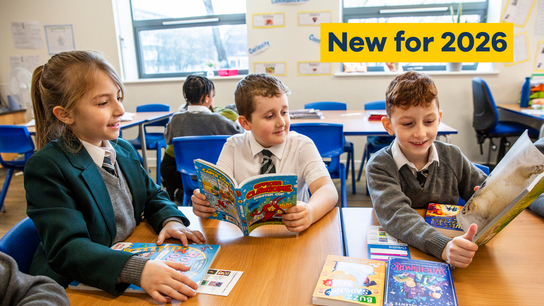
Reading might often be thought about as something that children do quietly on their own but our recent research highlights how important informal talk, social connections and opportunities for physical responses are to support and engage young readers (Cremin et al. 2025, 2024 and Hulston, 2024).
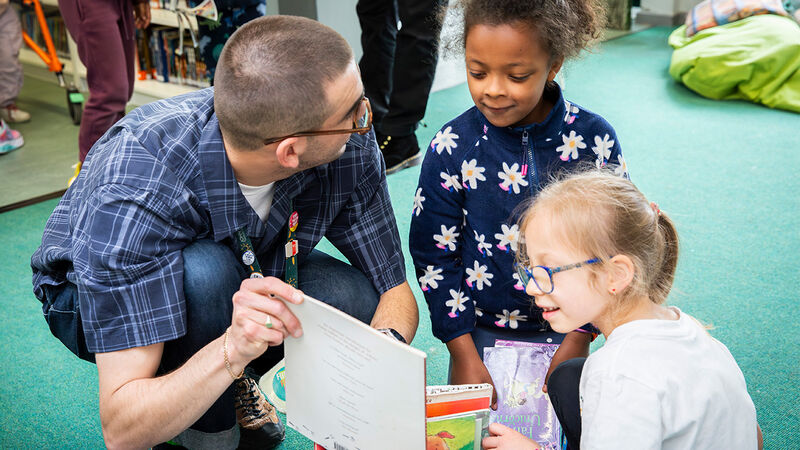
Informal interactions with friends, family members and educators about texts can send vital positive messages to children, and role model the pleasure to be gained in reading and sharing the experience of reading.
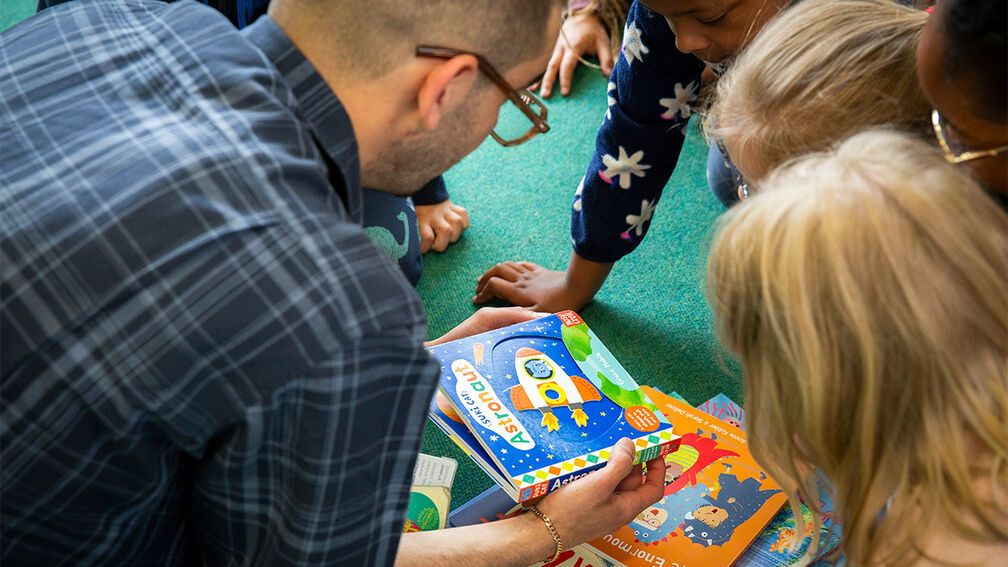
These experiences – from listening to a story to browsing a book box, looking at texts alongside others and hearing them chat about their reading – can give children a sense of a connected community of readers.
Talking about books has long been recognised as part of supporting children’s reading. The educationalist Aidan Chambers (1993) highlighted how adult-led questions can prompt a range of spoken responses from children, developing their understanding of texts.
However, although adult-led talk about texts can support young children’s comprehension, research suggests that when children are encouraged to informally lead the ‘talk’ about texts, including using gestures, noises and movements to communicate, they can explore aspects of texts on their own terms and generate meaningful social connections.
These opportunities help to create enjoyable experiences of reading for young children and build confidence and motivation to read.
There is no shortage of research that shows young children are positively bursting with things to say about texts; for example, Sipe (2008) observed young children making links between themselves and characters, connecting texts to ones they had already heard and playfully becoming part of a story to entertain their friends in class.
Giving children the opportunity for spontaneous book talk
Our study of informal book talk in the Early Years Foundation Stage and Key Stage 1 found clear social gains for 5–7‑year old children who were able to choose what, where and with whom to read, and to chat informally about their reading without teacher direction in different parts of their school day (Cremin et al, 2024; Rodriguez Leon et al. 2025).
Through spontaneous informal book talk about familiar texts, children formed new relationships – inviting others to look at and discuss texts together, pointing and sharing pictures and ‘snippets’ of information, or finding the funniest event in a story and reliving it through shared chat:
Alex, seizing this opportunity asked, ‘Do you want to read My Monster Smells Gross or Oi Frog?’. They [Alex and Aiden] both turned to the bookshelf to look for a text and after a few seconds excitedly chorused ‘Oh the Troll!’ ‘I love that book,’ Alex exclaimed. ‘Me too’ Aiden agreed, and they settled down with it, sitting close together and smiling in anticipation. (Cremin et al., 2024, p.936)
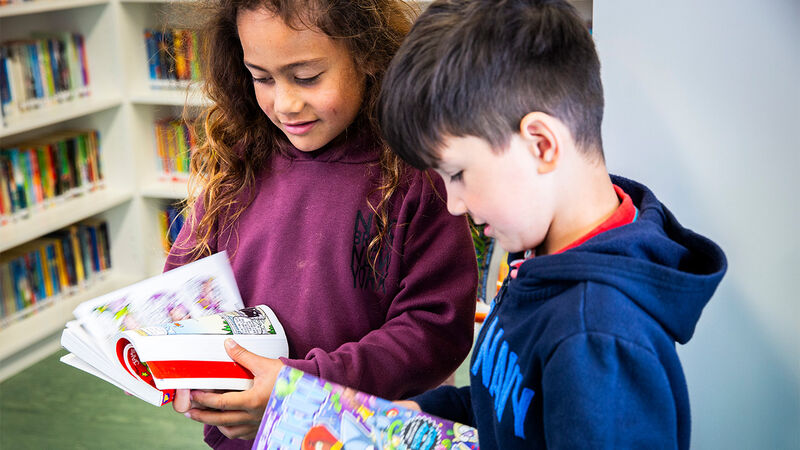
One child, often on the periphery of social interaction, engaged with peers because of shared excitement around a text. In another example, existing friendship relationships were also strengthened as children sat close together, relaxed, negotiating turning the pages and reciting bits of the story aloud.
The girls sitting very close together on the floor, each held the edges of the book which was lying across their laps. Mia stretched her arm across and gestured to Aabida to turn the page. Silently, they looked at the double page spread together, then Aabida observed, ‘Look out, a whale.’ ‘Amaaazing, it’s fun,’ Mia observed. (Cremin et al. 2024, p. 938)
The familiarity with texts generated through regular reading aloud and the opportunity to access and talk about these in their own time also enabled a child new to English to lead the chat with her teacher, ‘asking’ through gesture and body language for new vocabulary and demonstrating her own knowledge of fruits in the story.
Throughout the data, children demonstrated complex and deep understanding of how texts work and how readers can interact with them.
The children’s chatter revealed expert understanding of how to navigate both information and fiction texts. Their shared responses indicated an awareness and enjoyment of the subtle interplay of pictures and words – often commenting on ‘hidden’ jokes or repeated refrains, anticipating and vocalising ‘loud’ moments in stories, and using complex text-relevant vocabulary, all of which were rehearsed and understood further in these shared interactions.
The link between shared reading and play
Children also use activities like role play and object-based play to informally explore and share their interests in texts (Flint, 2020).
Hulston’s (2024) recent study looked at how children explore texts using movements during an informal play-based activity called ‘storyworld play’. Looking closely at the movements of children during storyworld play provided useful insights into how children respond to, and share their interests in, stories.
Children repeated movements to explore parts of stories that appealed to them and changed their closeness to play-based objects dependent on whether they wanted to gain an overview of narratives or imagine themselves into stories.
Crucially, the children often made attempts to share these movements with their friends and the nearby class adult. Children would gaze at those near-by, hold out play-objects, encourage friends to mirror their movements, and lean closer to people, all seemingly to share their interests.
Rupert holds up two figurines and looks at them. He leans towards Sean and lifts the figurines towards him as he looks at one of them: “You stole my hat.” Rupert lifts one figurine and throws it at the other, as he remains looking at one of them: “Bah!” Rupert smiles and looks around before looking at the class adult (Hulston, 2024, p. 190).
The children appeared to enjoy this way of sharing texts and connecting with friends, with storyworld play being characterised by broad smiles and lots of laughter.
Children’s interest in texts, whether expressed through talk or movements is socially oriented. Children want to share what they know, think, and experience when exploring texts.
The range of research and our most recent studies reinforced the importance of giving ourselves time to engage socially around reading with young children.
Prioritising time and space to let children respond in different ways and have relaxed conversations about familiar texts with adults and each other appears to be a key foundation to engaging young children in reading.
- Chambers, A. (1993). Tell me: Children, reading & talk. Thimble Press.
- Cremin, T., Hendry, H., Rodriguez Leon, L., & Hulston, S. J. (2024). Informal book talk: Digging beneath the surface. Education 3 – 13, 52(7), 930–945.
- Cremin, T., Hendry, H., Chamberlain, L., & Hulston, S. J. (2025). Reading and Writing for Pleasure: An Evidence-Informed Framework for Practice. Routledge.
- Flint, T. (2020). Responsive play: Creating transformative classroom spaces through play as a reader response. Journal of Early Childhood Literacy, 20(2), 385–410. https://doi.org/10.1177/1468798418763991
- Hulston, S. J. (2024). An exploration into young children’s embodied engagement with storyworlds through curated storyworld play [PhD thesis, University of Cambridge]. https://www.repository.cam.ac.uk/handle/1810/372094
- Rodriguez-Leon, L., Hulston, S. J., Hendry, H., & Cremin, T. (2025). Informal Book Talk. In Reading for Pleasure: International Perspectives. Routledge.
- Sipe, L. (2008). Storytime: Young children’s literary understanding in the classroom. Teachers College Press.