Our Writer in Residence Tom Percival explores the different ways that books and stories can help to spread joy in our lives.
Tom Percival is an author, illustrator, and BookTrust’s current Writer in Residence
When I was 18, I worked for a year on a magazine called Positive News — a job that turned out to shape the rest of my life far more than I thought it would at the time. 30 years on, I can see just how much I absorbed in that year.
The magazine’s whole ethos was that the world is, was, and probably always will be full of bad news. That’s hardly a revelation to anyone who’s ever opened a newspaper. But Positive News made the case that the world is also full of good news — and that spreading joy is just as important and worthwhile as informing people about the world’s problems.
It’s an aim I can get behind. And, as it just so happens, it’s something that reading can help with too…
Books have genuinely increased my happiness over the course of my life, so here are a few of the ways reading has done that for me, how it might do the same for all children, and why it’s worth making more room in YOUR life for.
Books bring connection
There’s an old saying — “you’re never alone with a book” — that rings true for a few reasons.
First, there’s the conversation with the author. It’s a dialogue that can stretch across years, decades, even centuries, between people who might have very little understanding of each other’s lives and cultures.
This is one of the most beautiful things about reading. When you share a book with a child, it can’t help but broaden their understanding of the world, of other people and different cultures.
No matter how long ago a text was written, those common threads of humanity run between the reader and the writer, and the more a child reads, and the more voices they hear, the clearer it becomes that fundamentally we all need the same things – community, care, warmth, friendship, and love.
If we’re talking about a story, whether it’s a picture book, a novel, a graphic novel, or a comic book, there’s also the connection you can feel to the characters themselves. Sometimes these characters can start to feel as real as flesh-and-blood people.
A portion of the 40th anniversary edition of the Dragonlance Chronicles. Image: Sally Taylor
Books can even help make you friends, quite literally. In my first year of secondary school, I connected with a whole load of other readers because we were all really into the Dragonlance series of books.
We would copy the artwork from the book covers and chat about our favourite characters and scenes in the books, as though they were real events that had actually happened. That super-shiny airbrushed Dragonlance logo is STILL etched into my brain – the absolute pinnacle of 1990’s graphic design!
People are always looking to find connection, and joy through shared passions and reading is a great way to do that. Either in family units as a wind-down evening activity, or school settings where all children hear the same class read at the same time.
Sometimes that sense of connection comes through recognition: seeing a character wrestle with something you struggle with yourself and feeling less alone for it. Books for teenagers that explore LGBTQ+ experiences, or cultural, financial, and societal diversity, matter enormously here — they help readers feel seen, which supports their mental health and wellbeing.
Books open doors
Image: Tom Percival
A book can spark a whole new passion or hobby, and send you off exploring the world, and by extension, yourself.
I’ve travelled to places purely because they inspired the setting of a book that I loved. I’ve sought out musical genres that a character I like has been passionate about, and gone down various rabbit holes, digging into historical periods that I might never have considered if it wasn’t for a good book pointing the way.
I’m not saying that the instant a child picks up a book they will become the picture of fulfilment and happiness, but all the things I describe above help to enable joy — to bring about the fertile grounds of connection, self-confidence, curiosity and discovery that joy can then grow within.
Tom Percival, BookTrust Writer in Residence
And that’s before we even get to the quieter benefits: better focus, a richer vocabulary, and increased empathy.
In a time of constant stimulation and shrinking attention spans, picking up a book feels like a small act of rebellion — a pushback against every intrusive app design that has children reaching towards a screen for another immediate dopamine hit.
The lure of screen-based entertainment is undeniably strong, and something that both children and adults can struggle with. The challenge we face is that a lot of the media made available online isn’t especially good for children’s mental health.
And when you constantly hear bad news, it’s very easy to become fixated on everything that’s wrong with the world, making it easy to forget that the world is also full of kindness and beauty.
The good news is that our brains are very malleable, and we can train our ourselves to view things in a more positive light too.
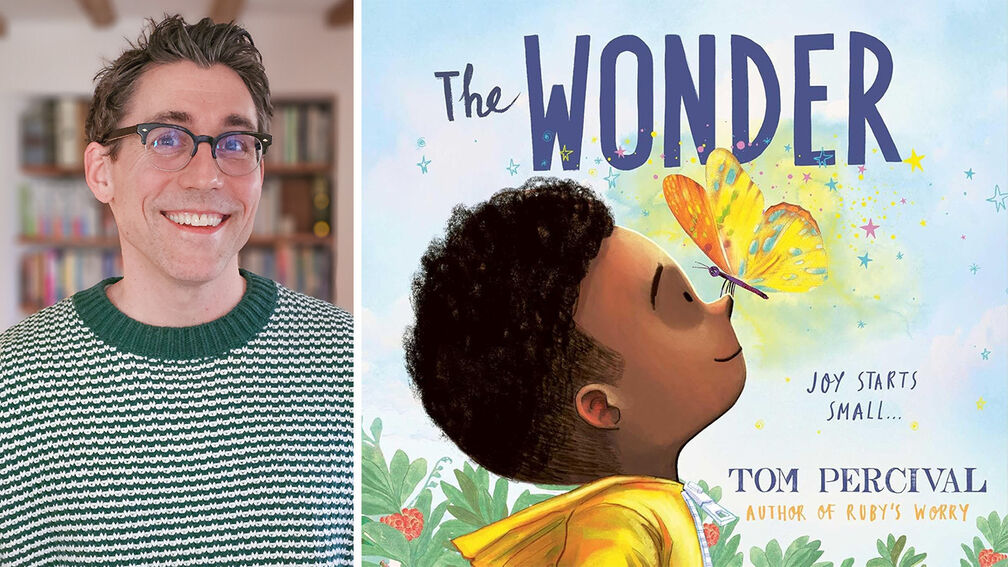
By stepping away from the constant cycle of immediate, digital entertainment, reading can help children to slow their pace a bit, to improve their focus, to take the time to make the effort to notice and celebrate the joy and wonder that exists. That’s what my book, The Wonder, is about.
It’s not about pretending everything is always sunshine and roses; it’s about acknowledging the world’s very real challenges, openly and honestly, while still making time and space for beauty as well.
Because the more children look for kindness, beauty, joy and wonder, the more they will find it. And the more they find it, the more they can help create it — for themselves, and for everyone they meet along the way.