Our Writer in Residence, Tom Percival, shares his experience of the unique power of books to connect adult and child.
Tom Percival is an author, illustrator, and BookTrust’s current Writer in Residence
A sense of connection is something we all want from life. A need to be seen, to feel close with our friends and to understand the people around us.
But how, how on Earth, can we possibly achieve this? Well, being as I’m currently BookTrust’s Writer in Residence, I feel it would be remiss of me not to mention the massive part that books play in building connection.
How sharing stories makes us feel
This bonus superpower that books have is something I realised very early on.
When I was young, my mum read to me and my brother all the time. At bedtime, bath time, and if we were ever waiting anywhere, she’d whip a book out of her handbag and start reading.
She carried on long after we were more than capable of reading independently, and I loved it – everything about it!
I loved the stories, obviously, but the thing that sticks in my head most about all those many, many hours of being read to isn’t the plots (I can’t even remember the titles of most of those books, let alone what happened within the pages). It was the feeling.
The warmth, the comfort, the sound of my mum’s voice, the security.
Because that’s what you really give a child when you share a story with them. Your full, undivided attention.
You’re sharing a moment in time where any problems drift away and you are both focused on the same thing, together.
You or the child you’re reading to (possibly even both of you!) might be feeling tense, upset, tired, sad, worried or angry beforehand, but once you settle down, get comfortable and start reading, all of that uncomfortable energy drifts away.
It’s a great ‘reset’ for when emotions are heightened and young children are feeling frustrated. So, it’s no exaggeration to say that reading together is a healing experience.
Sharing stories is always worth it
But let’s be honest, it’s not what you always want to do. When my children were young and I was often exhausted and sleep-deprived, the thought of a bedtime story did not exactly fill my heart with joy (#HonestParenting!)
When all you want to do is curl up in a ball yourself, picking up a book can feel like a challenge, but I promise it is always worth it. Not just because you’re encouraging a love of reading in your child, along with all of the many proven benefits that brings, but because it will make you feel better too.
It’s like going for a walk on a bad day. Maybe you don’t want to? Maybe you can’t be bothered? You’re too tired, too stressed, too whatever… but then you (begrudgingly!) put your boots on and stomp outside.
You don’t notice any improvement at first, but by the time you return home you feel lighter, calmer, happier, as though your problems don’t feel quite so sharp anymore. Sharing a story together feels exactly the same.
Feeling comfortable reading aloud
I understand that reading aloud can be a challenging thing to do.
I have a slight lisp that I became quite self-conscious about as a teenager, because… well, I was a teenager, and teenagers aren’t always especially nice to each other!
Anyway, the point is that reading aloud can be hard for all sorts of reasons, but this is where a very special type of book comes into play. Can you guess what sort? I’ll give you a clue, I’ve made loads of them… picture books!
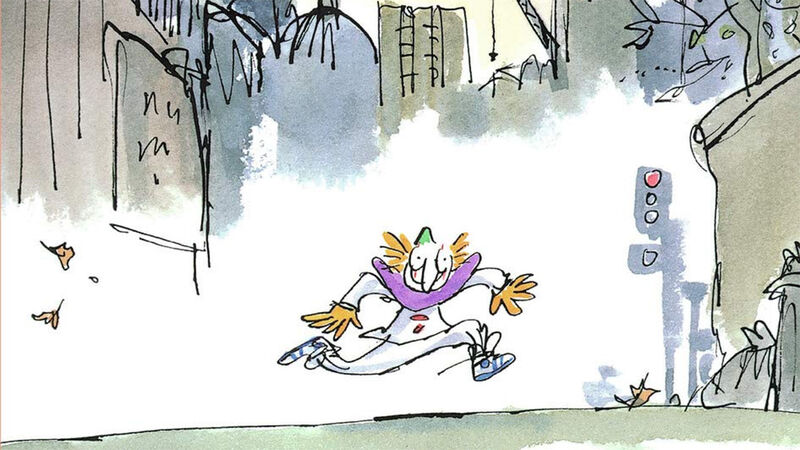
Image: Sir Quentin Blake
The great thing about picture books is that some have hardly any words but are packed full of story. The Clown by Quentin Blake doesn’t have a single word in it but has a really rich, detailed story.
You can sit together and look at the pictures, asking the child questions about what’s happening. Questions like: how do you think the clown feels here? (As long as there is a clown in the book you’re looking at, otherwise that question will totally confuse them!)
And the good news is that just like anything else, you can improve at reading aloud. If it’s something you feel uncomfortable about, try taking a short, simple book out from the library and reading it aloud on your own a few times. No pressure, with no audience or anyone else around, just you getting comfortable with the feeling of it.
Stick with it and soon it will be something you get as much out of as the child you’re reading to.
How both children and adults benefit from sharing stories
So, I was read to a lot as a child, and as a result I read to my own children a lot, and I’ve benefited immensely from both being the listener and the reader.
I’ve shared every possible emotion through these stories, whether putting on funny voices for the characters to make my children laugh, or listening to my mum’s soft voice carrying me off on distant rivers of adventure when I was young.
All those hundreds, probably thousands, of shared stories have sparked conversations and given me, my mum, and my children the opportunity to understand each other and the world a little more.
We’ve laughed, cried and felt a shared sense of wonder and excitement, we’ve grown, learnt, changed and developed, sharing time, space and every possible emotion, all while feeling warm, comfortable and secure.
This briefing provides an overview of BookTrust’s own insights and wider research which demonstrates that reading is not just a literacy or learning activity, but a relational one.