As well as being an author, I’m a mother to three children, all via adoption. I’ve also worked as an independent panel member for both adoption and fostering agencies.
Reading has been a massive part of my bonding journey with all my children in different ways, and it started when my wife and I adopted our eldest child, who was three years old at the time (he’s twenty-one now – where does time go?!).
When children are adopted, they have often been through a turbulent time, lacked a steady and secure reliable adult, and missed out on the routines that many of us consider part and parcel of family life. Many are often in a state of high alert, wondering what will happen next.
Forging bonds at this time is crucial. It’s not always easy, but sharing books can help.
Bonding through books
With our eldest, we initially used books as a source of fun, and to encourage him to unwind. We quickly established a routine of snuggles and stories – a cosy and safe space to share feelings, giggle, ask questions, and relax.
We shared stories that brought out our silly sides, showing him that adults are fun. This developed his trust and, importantly, helped him to start to form positive attachments to us.
Bonding over characters
My wife and I then bought and borrowed books that validated our son’s emotions. We found that fictional characters often provided a brilliant, non-intense way to explore emotions and normalise feelings.
We also pretended to struggle on words to show him that it’s okay to make mistakes.
Bonding through positive representation
We also shared stories that represented his past and present, so he could see that he wasn’t alone in his experiences, and begin to feel secure in his identity.
Amongst our bookshop hauls and library loans, we always ensured we had books that contained characters that were adopted, characters with two mums, characters who had been in foster care etc., and he loved some of these.
I vividly remember sharing the book Picnic in the Park by Joe Griffiths and Tony Pilgrim over and over again at his request. It’s a simple book about a little boy celebrating his fifth birthday in a park. Lots of different families come along… and they’ve all brought presents!
For us, this was a great book as it opened up conversations about different family structures, including those like our own, and those like families where he’d lived before, including foster families. For him, the book validated his past and present. ‘Like me!’ was a key phrase we loved hearing him say. He took the book into his nursery class to show his peers and teachers. The book helped him to feel secure about sharing what his family looked like.
As an author, I know that when a child sees a version of themselves in an uplifting book, they feel validated and their self-confidence improves. It’s one of the main reasons I write comedies that reflect diverse family structures. Plus, there’s robust evidence to prove that representation is the key to successful reading for pleasure – and, as BookTrust research shows, reading for pleasure from an early age can have a massive impact on life-chances and wellbeing (something, as adopters, we always want to encourage).
It’s certainly not one size fits all when it comes to representing adopted children, and never under-estimate the value of sharing a book where a loving adoptive family is the setting for the story as opposed to the main focus of the plot. It’s a brilliant normaliser.
Bonding with babies
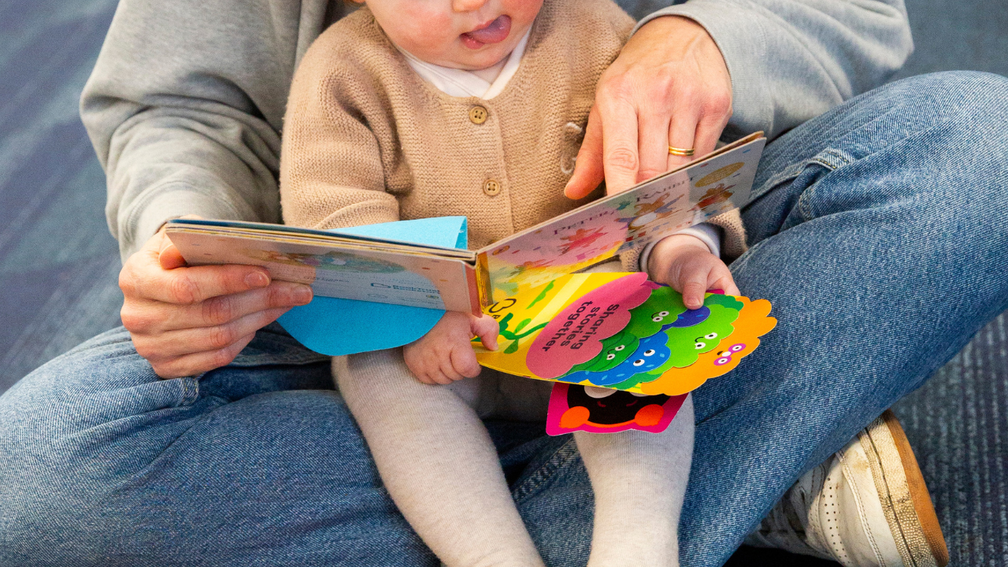
Our following two children came to us as babies, and sharing a variety of books was something we established immediately as part of our bond-building process. We sang our way through board books, put on all sorts of dodgy accents sharing picture books, and were regular attendees at baby book and singing groups. Books were amongst our tools for easing emotions and developing communication, mostly accompanied by cuddles and laughter. Again, bonding over books.
And when they got older, we had all the brilliant dog-eared books we’d shared with our eldest, plus lots of new ones that were released after publishers jumped on board with the way the world is changing in terms of family structures.
Bonding through being present
Having a present adult is the key to all children’s well-being. And reading or sharing books is a fantastic way to be present.
We continue to bond over books with our youngest who is neurodivergent and, at nine years old, still loves picture books. Just last night, for example, I read her a story about a character who had to have an eye test (something she has to have regularly, but doesn’t enjoy). The simple text and bright illustrations helped her to verbalise some of her emotions. Fingers crossed, having shared this book on her terms, and in a safe and happy environment, will help when we return to the hospital next week!
Jen Carney is an award-winning author-illustrator of middle-grade (ages 7–11) contemporary comedies that celebrate modern families:
The Accidental Diary of B.U.G. series (a three-book laugh-out-loud diary series narrated by Billie Upton Green – a sparky ten-year-old with two mums who, incidentally, adopted her when she was a baby)
and
The Day My… series (a three-book comedy adventure series narrated by Ferris Foster – a kind-hearted ten-year-old whose mums are foster carers).
Find books on related topics…
-
At BookTrust, we know the value of children seeing characters like them in books, and of seeing different families too. We asked author Liz Kleinrock to talk about the importance of including adopted characters in children’s books.
-
Author Ian Eagleton recommends five favourites.
-
Highlighting the many permutations of family life in our society, these stories celebrate the beautiful diversity of what it means to be a family