
Generally speaking, everyone finds something funny, or amusing. It’s human. It’s what separates us from the molluscs. I’ve never seen a snail laugh, just saying. Humanity is relatable and it’s the one thing all my readers have in common (excluding AI). The ability to laugh or experience joy is part of humanity.
There are lots of different types of humour. For example, clever wordplay, which makes me smile. Also gags about bodily functions and anatomy – smelly butts and the like – can be very funny, and really resonate.
Once children have learnt to read, ideally, they will stop thinking of reading as homework and just enjoy it. And what could be better than a funny book when they’ve just started reading for pleasure? This age range are about a decade early for dystopian thrillers.
The first piece of advice I ever got from my agent was “don’t talk down to your readers”, which might have been my natural inclination as a debut writer. I have fun when I’m writing, and it helps to not be overly conscious of the age of the reader. Children love humour, but they are some of my harshest critics, their honesty can be devastating at times. I’ve learnt that they understand so much more than they’re given credit for. The look of exasperation, and the grins on their faces when they hear wordplays and puns, are just as rewarding as the belly laughs at zany absurdity. I find freedom in that; I can push the humour as far as I can, mixing silly and subtle with fart jokes and puns.
This freedom, and confidence in my young readers, opens the door to so much fun. If laughing at the story gives them confidence, that’s great. If it keeps them reading, even better.
So when I’m writing humour, I tend to start with what I find funny. And how I can work that into the story. So what’s something I find funny that the readers can relate to?
Answer: flatulence. Easy. So, the mayor of my fictional town in Solving Crimes is Not My Superpower has colourful farts.
What else? Main characters pulling silly faces and doing a funky dance? I think so! My brain relies on visual humour, so this kind of scene amuses me.
Thankfully, we have an illustrator who can help bring that humour to life, the brilliant Simran Diamond Singh, so that readers who might not see the visual gags in their heads like I do can still see them on the page. Illustrators add that extra magic to any book, especially funny books. Seeing the funny scenarios as well as reading them can push the humour much further, adding another layer of laughter. And children love to look at the pictures – adults too. Funny pictures should be universally enjoyed for as long as possible; I’ve not heard anyone ever complain about a children’s book being too playful.
And, as with my teen books, I rely on real life anecdotes where I’m not creative enough to think of amazing scenes. In Solving Crimes is Not My Superpower, Javier has the idea to disguise himself as a bunch of grapes, by wearing dozens of purple balloons. True story, my mum actually did this to my younger brother. World Book Day, nineteen-ninety something, she’d been reading Aesop’s fables. She particularly liked one about a fox who couldn’t reach a bunch of grapes. Strapped for cash, my mother sent my brother to school in a ‘grape costume’. She made him wear a baggy purple t‑shirt (not uncommon dresswear in the 1990s) and attached a couple dozen grapes to him. I’m not sure if anyone guessed what book he was from.
Funny, weird things happen all the time – to me, to people around me, to complete strangers. And the humour that I see in the real world is perfectly translatable into writing fiction. Sometimes humour is the best way to process what’s going on around us, for any age group. The collective human experience of finding a particular thing funny transcends boundaries like race, gender and economic background. When a diverse group of children are laughing at the same thing, it’s perfect for the classroom as it brings them together. It might also highlight what they have something in common, even if that “something” is just silly toilet humour.
Humour isn’t just a tool that keeps the reader engaged, it keeps me engaged. And when I’m engaged, the reader benefits. It’s the circle of life, or the circle of something biologically dramatic.
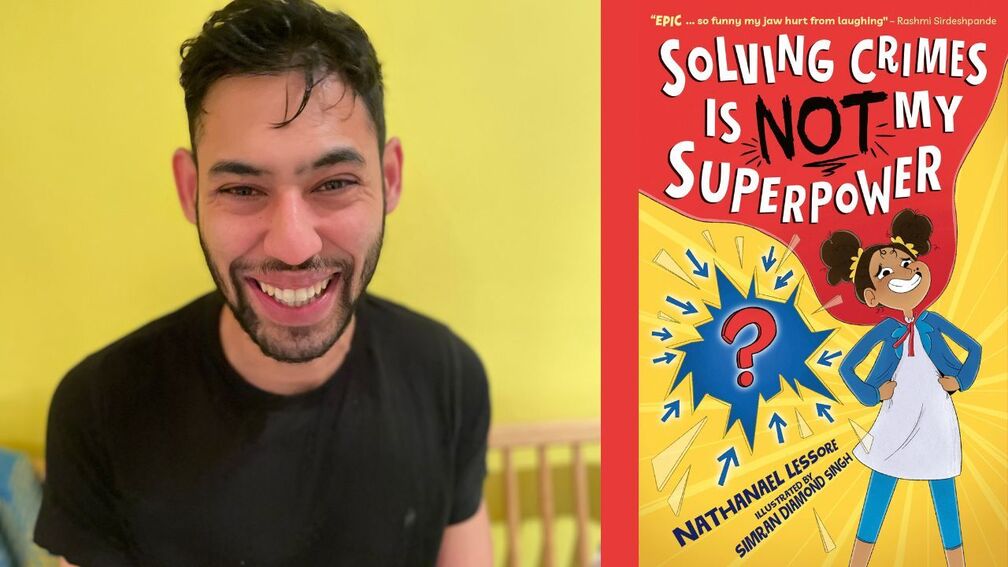
Solving Crimes is Not My Superpower by Nathanael Lessore, illustrated by Simran Diamond Singh, is out now.