What I love most about folk tales from anywhere in the world is that they show us plenty of universal truths, human qualities, and lessons to be learned. Folk tales reveal just how similar we are as people in a way that transcends our cultural and geographical differences.
I grew up in a British-Caribbean household, third generation of Jamaican migrants, and was fortunate to have a grandad who still told me stories from ‘home’.
But as a child I also had access to literature that strengthened my link to the Caribbean lands my grandparents migrated from: books such as Grace Hallworth’s Mouth Open, Story Jump Out, and the Oxford West Indian Folk Tales retellings. The former introduced me to the spookier side of Caribbean cultures, while the latter solidified the status of the region as bright, colourful, and full of character.
Here are five reasons why kids will fall in love with folklore from Jamaica and other Caribbean islands.
1. Laughs and lessons
Caribbean tales are full of folk wisdom. Anansi the spider might possibly be the most famous trickster in all world folk tales. Sometimes he’s on the right side of the trickery; other times he cuts a hapless figure whose own craftiness gets him into trouble.
These are teachable moments told with great humour. We laugh at his misfortune because we recognise the mistakes he makes and anticipate the inevitable blowback ahead of time. As kids we can learn how not to act from a place of safety, without experiencing it ourselves.
2. Underdog energy
Everyone loves rooting for an underdog, right? Anansi originates from the Akan people of what’s now present-day Ghana. The lore travelled from that region to the Caribbean with enslaved West Africans during the transatlantic slave trade. The spider figure is known, and loved, for outsmarting larger, stronger beings.
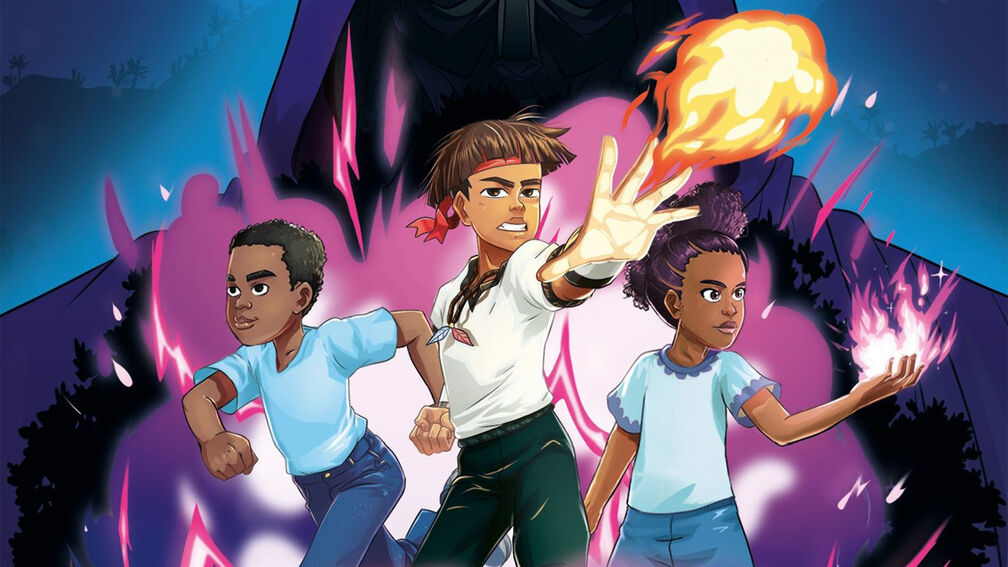
There’s definitely a lot of Anansi energy in my latest novel Spirit Warriors, in which the core trio Evie, Arthur and Cai are the underdogs vs some pretty diabolical reimaginings of fiends from Jamaican folklore. Which leads nicely to…
3. Some of the creepiest ghost stories you’ll ever hear
If you’re anything like I was as a child, then you would have enjoyed the thrill of being a little scared by ghost stories. You hang on to every word, whether spoken or written, and even though there are goosebumps all over your body, you come back to the stories again. And again.
Grace Hallworth’s book introduced me to several duppies (evil spirits). But the fiends who gave me the biggest scares as a child now have a huge antagonistic role in Spirit Warriors. La Diablesse (Devil Woman) is a duppy who appears as a beautiful woman, but hidden under her long dress is one foot like a cow’s hoof, and her wide-brimmed hat hides a ghastly true appearance.
Blackheart Man (called Heartman on some Caribbean islands) is a cautionary tale for children not to be out late or on quiet roads at night. In the lore, he tempts children away and eats their hearts!
These legends have been modified in Spirit Warriors in a way that doesn’t separate the monsters from their humanity, which I hope makes them even more intriguing and terrifying as a consequence!
4. Helps young readers and storytellers of the future to learn classic story conventions
Short and sweet Caribbean folk tales are punchy because they have to be. They draw you in and give you a succinct and satisfying beginning, mid-point, and conclusion to a tale. These are extremely useful conventions for children to recognise when it comes to writing their own stories.
The length and nature of these memorable tales also greatly help young readers to be able to follow plotlines – something with immense value in this current period of falling literacy rates.
5. Fosters cultural appreciation
It’s estimated that over 300 languages are spoken across Britain, representing a broad cultural makeup that comprises modern Britain. There’s immense joy and excitement to be found in learning about the different histories, tales and cultures of everyone who makes up our society.
It helps us to find common ground, and to appreciate different perspectives. At a time when we’re objectively less emotionally connected, books and stories can be a powerful way to bridge these ever-growing gaps.
Spirit Warriors by Ashley Thorpe is available now.