Bookstart Booklet
Thank you for taking part in our Bookstart development project. We are so pleased to be working with you, as you play a vital role in helping us support families establish early reading habits.
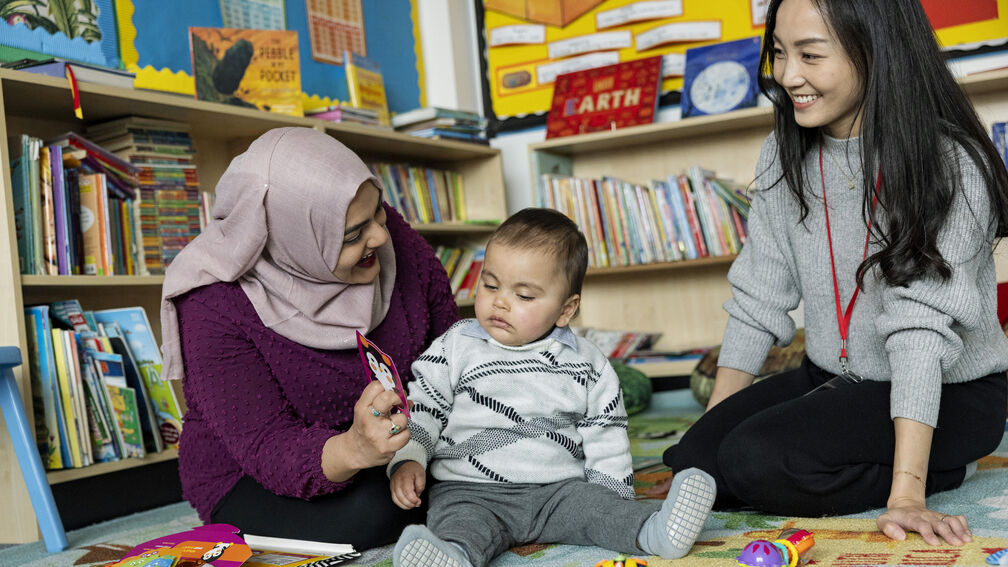
Video briefing on the Bookstart booklets
Why the first few months matter
Evidence shows that language, social, and emotional development are shaped from birth, with these foundations beginning even before then, during pregnancy. This is why we are focusing this work on the antenatal period and the first few months of a baby’s life.
By around 15–20 weeks of pregnancy, the parts of the ear needed for hearing are forming, and from about 24–36 weeks, babies begin responding to sounds and familiar voices in the womb [1]. Studies also show that newborns continue to recognise and are soothed by their mother’s voice, highlighting how these early sound experiences support brain organisation and bonding [2].
Talking, singing, and reading from pregnancy onwards help build early brain connections and strengthen bonds, laying foundations for later language, social, and emotional development. Find out more in our science behind the benefits of reading for babies research and benefits of reading evidence review.
Your vital role
Families are more likely to share stories when trusted professionals – like midwives and health visitors – model how to do it. Showing parents how to hold or prop up the booklet so baby can see, point to pictures, and talk to their baby helps them see that simple moments matter.
Reassure parents that there is no single right way to share books. What counts is time spent looking, talking, and connecting together.
Parents often worry about “doing it right.” You can help them feel more confident by emphasising that talking, looking at pictures and enjoying time together are what matter. And that there is no wrong way to share a book.
You might use the booklet to:
- talk to parents about reading and its benefits
- model the ways in which the booklet can be used to interact with new-borns, reading together and pointing to the images
- show parents of older babies how the booklet can be used to support tummy time
We want to emphasise that the booklet can be used at a variety of different appointments, at a variety of different times.
Your knowledge of and relationships with the families with whom you work makes you best placed to decide where it will be most helpful. We know you are used to working in flexible and creative ways with the families you support, and so we want you to use the booklet in the way that is most effective for you, and then to tell us about where the resource has worked best and why.
Resources to support families starting their reading journeys
More tips and advice on how to support families to start their reading journeys.
-
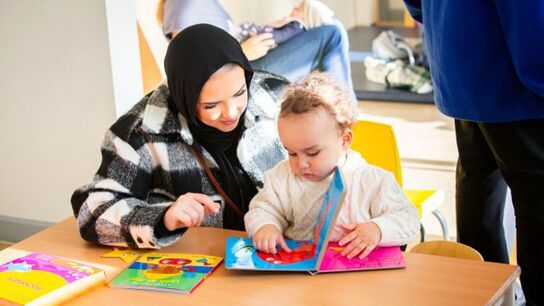
Programmes, tools and resources for those working with children and families to support the education and development of young children.
What next
Direct families to the resources on our website through the QR code on the Bookstart booklet. There are booklists on our website showing the best books for 0–1‑year-olds. Baby books with pictures and interaction are a great first step – it’s about sharing stories together to build bonding and closeness.
[1]
Graven, S. N., & Browne, J. V. (2008). Auditory development in the fetus and infant. Newborn and Infant Nursing Reviews, 8(4), 187–193.
Hepper, P. G., & Shahidullah, B. S. (1994). Development of fetal hearing. Archives of Disease in Childhood: Fetal and Neonatal Edition, 71(2), F81–F87.
Kisilevsky, B. S., Hains, S. M. J., Brown, C. A., Lee, C. T., Cowperthwaite, B., Stutzman, S. S., Swansburg, M. L., Lee, K., Xie, X., Huang, H., Ye, H. H., Zhang, K., & Wang, Z. (2008). Fetal sensitivity to properties of maternal speech and language. Infant Behavior and Development, 32(1), 59–71.
Voegtline, K. M., Costigan, K. A., Pater, H. A., & DiPietro, J. A. (2013). Near-term fetal response to maternal spoken voice. Infant Behavior and Development, 36(4), 526–533.
[2]
Fifer, W. P., & Moon, C. M. (1994). The role of mother’s voice in the organization of brain function in the newborn. Acta Paediatrica Supplement, 83(397), 86–93.
Partanen, E., Kujala, T., Näätänen, R., Liitola, A., Sambeth, A., & Huotilainen, M. (2013). Learning-induced neural plasticity of speech processing before birth. Proceedings of the National Academy of Sciences of the United States of America, 110(37), 15145–15150.