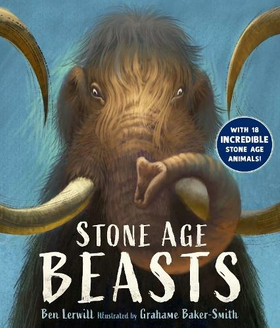
Stone Age Beasts
by Ben Lerwill, illustrated by Grahame Baker-Smith
Interest age: 6 to 8
Reading age: 6+
Published by Walker Books, 2023
About this book
Three million years ago, humans had just started making stone tools. This was the beginning of the Stone Age, which only ended about 4000 years ago – not very long, in the grand scheme of things.
During the Stone Age, things would have looked rather different, both in terms of the world map and different climates that encouraged different species to thrive.
In this fascinating picture book, Ben Lerwill describes 18 stone age animals that are now extinct. Some, you might have heard of, such as the sabre-tooth tiger; some, like the Siberian Unicorn, might be more of a mystery. Yet, humans lived alongside these (often giant) animals, and often hunted them for their skin, meat or bones.
Each animal is explored in a double page spread, beautifully illustrated by Grahame Baker Smith, featuring an accessible fact panel for each animal, and fun and readable facts about the animal’s habitat, habits, food and prey.
A fascinating and beautiful resource for primary schools studying the Stone Age, and for young animal fans at home.
More books like this
-
24 Hours in the Stone Age
by Lan Cook, illustrated by Laurent King
5 to 14 years
-
Wild Family
by Ben Lerwill, illustrated by Harriet Hobday
9 to 14 years
-
I'm Not Scary ... I'm Just a Dinosaur!
by Ben Lerwill, illustrated by Erica Salcedo
3 to 7 years
-
Wonder World: Earth
by Ben Lerwill, illustrated by Xuan Le
5 to 7 years
Lists of recommended reads
-
Stone Age to Iron Age history topic booklist
Stone Age to Iron Age Britain features in the history curriculum for primary schools across England and Wales, and children are often curious to learn more about this fascinating era. We have hand-picked a selection of books which connect with this period, and which would work well alongside a history topic.
-
Animal non-fiction
Surprising facts, statistics, similarities, differences, relationships, habitats, behaviours and more that make our natural world so unique