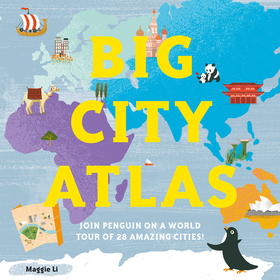
Big City Atlas
by Maggie Li
Interest age: 6 to 11
Reading age: 7+
Published by Pavilion, 2020
About this book
Take a whistle-stop tour around 28 of the world’s most amazing cities; soak up the culture, traditions, prominent landmarks and local food experiences with a cheery penguin guide in this bright and engrossing pictorial feast.
With a double-page spread for each city, why not stop off for tortillas and guacamole in Mexico City, pie and mash in London, biltong in Cape Town, pizza and gelato in Rome and sushi in Tokyo?
If you are more interested in local traditions, myths and legends, sporting achievements or stunning buildings and history, don’t worry – there’s plenty in this stunning reference book for you too. Maybe you’d like to know about the grisly diet (and even grislier sacrificial rituals) of the Aztecs, camel beauty contests in Dubai, or the cemeteries in Cairo where many of the poorest families now live? Look no further, this is the book you’ve been waiting for!
This super-accessible trip around the world is presented as pictorial city plans with illustrated places of interest and added text boxes packed with fascinating facts. Children will enjoy poring over the detailed pages and testing their knowledge with ‘find it’ features for younger readers and games and quizzes for older children.
More books like this
-
Old Enough to Save the Planet
by Loll Kirby, illustrated by Adelina Lirius
5 to 14 years
-
Dig Dig Dinosaur
by Professor Anjali Goswami, illustrated by Maggie Li
2 to 4 years
-
Little Life Cycles: Frog
by Maggie Li
2 to 4 years
-
Mixed
by Emma Slade Edmondson, illustrated by Tasia Graham
9 to 14 years
Lists of recommended reads
-
Books about geography around the world
Learning about geography isn’t just memorising maps and flags; it also encompasses the study of people and their relationship to the places they live. In this booklist, we have collated a selection of contemporary books which share the brilliant diversity of our planet. Some explore physical features of the world like volcanoes, mountains and water systems, while others look at the human side of geography: exploring the cultural histories, similarities and differences which make up our global society.