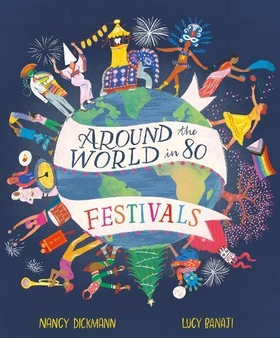
Around the World in 80 Festivals
by Nancy Dickmann, illustrated by Lucy Banaji
Interest age: 9 to 11
Reading age: 9+
Published by Welbeck Editions, 2022
About this book
People around the world celebrate thousands of different holidays and festivals. Many may form part of a religion, but others remember loved ones who have died, or historical people and events. Many have been celebrated in the same way for hundreds or even thousands of years.
Food and dressing up is also often part of festivals from a variety of cultures, from the Cheung Cahu Bun Festival in Hong Kong, where a contest sees climbers scale an 18-metre tower covered in rice flour buns, or Festima in Burkina Faso, a festival that celebrates the ancient tradition of mask-wearing in African culture.
Featuring festivals from Europe, Asia, Africa, the Americas and Oceania, this colourfully illustrated book also features chapters on ancient festivals, food and festivals, dressing up and a lovely fold-out section that shows a year’s worth of festivals from around the world, including festivals using the lunar calendar. It’s a great introduction to the variety of cultures and religions around the world, and acts as a super starting point for children to research more about the ones they’re interested in.
More books like this
-
The World’s First Human Cannonball and Other Incredible Jobs
by Mike Barfield, illustrated by Franziska Höllbacher
9 to 14 years
-
Wild Planet The Inspiring Life and Wisdom of Sir David Attenborough
by Hayley Rocco and John Rocco
9 to 14 years
-
Mathematicians are Counting the Stars!
by Saskia Gwinn, illustrated by Ana Albero
9 to 14 years
-
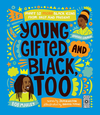
Young, Gifted and Black, Too
by Jamia Wilson, illustrated by Andrea Pippins
9 to 14 years
Lists of recommended reads
-
Books about geography around the world
Learning about geography isn’t just memorising maps and flags; it also encompasses the study of people and their relationship to the places they live. In this booklist, we have collated a selection of contemporary books which share the brilliant diversity of our planet. Some explore physical features of the world like volcanoes, mountains and water systems, while others look at the human side of geography: exploring the cultural histories, similarities and differences which make up our global society.