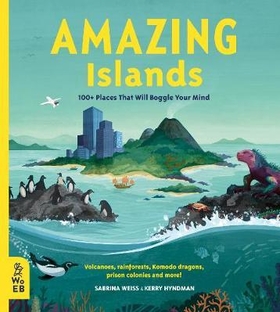
Amazing Islands: 100+ Places That Will Boggle Your Mind
by Sabrina Weiss and Kerry Hyndman
Interest age: 9 to 11
Reading age: 8+
Published by What on Earth Books, 2020
About this book
Some islands are huge, like Greenland, which is a whopping 2,166,000 square kilometres in size. Some are so tiny that they might never have existed at all, like Sandy Island, sighted by Captain Cook in 1774, which scientists couldn’t find in 2012. Some bigger islands are also in danger of disappearing – Kiribati in the Pacific Ocean is under threat from rising sea levels. If climate change continues to cause glaciers to melt, 100,000 people that live there on 33 atholls (small islands) will have to leave.
Many famous places that sound like one place, like Venice and the Philippines, are actually a number of islands: Venice is built on 118 islands that are linked together by more than 400 bridges, and the Philippines comprises over 7,600 islands, with 2,000 of them inhabited.
Spanning prison islands, river islands, barrier islands, mystery islands (like Fadiouth in Senegal, which is made entirely from shells), island cultures and many, many other fascinating topics, Weiss and Hyndman’s colourful, stylish book is full to the brim with fascinating facts.
About the author

More books like this
-
Nature's Fascinating Friendships
by Mike Hills, illustrated by Kerry Hyndman
5 to 9 years
-
Skygazing
by Anna Claybourne, illustrated by Kerry Hyndman
5 to 14 years
-
Heroes: Incredible True Stories of Courageous Animals
by David Long and Kerry Hyndman
5 to 14 years
-
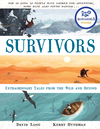
Survivors
by David Long, illustrated by Kerry Hyndman
5 to 14 years
Lists of recommended reads
-
Books about geography around the world
Learning about geography isn’t just memorising maps and flags; it also encompasses the study of people and their relationship to the places they live. In this booklist, we have collated a selection of contemporary books which share the brilliant diversity of our planet. Some explore physical features of the world like volcanoes, mountains and water systems, while others look at the human side of geography: exploring the cultural histories, similarities and differences which make up our global society.