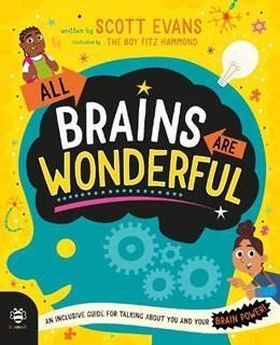
All Brains Are Wonderful
by Scott Evans, illustrated by The Boy Fitz Hammond
Interest age: 9 to 11
Reading age: 7+
Published by b small
About this book
Did you know that the sperm whale has the biggest brain, while the larval sea squirt has the smallest? And that some animals, like jellyfish and starfish, don’t have a brain at all!
Meanwhile, human brains work in very different ways and they can keep changing throughout life.
This celebration of brains is a comprehensive guide to how they work – from how they form, to how much work they do, to how to train your brain – and how they can differ. There are three sections: Science, Society, and Taking Action.
The neuroscientist Dr Rachel S.H. Williams has given expert advice, including information on neurological disorders (like cerebral palsy, epilepsy and dementia) and neurodiversity (like dyslexia, autism, and dyspraxia). There are a lot of technical terms in this fascinating book, yet it’s presented in a clear, age-appropriate way.
The section on society covers the fact that being neurodiverse is not a disability, and that it’s important to treat everyone fairly and with respect, including listening to how they talk about themselves. Finally, there are tips on how to rest and feed your brain (and to ask for help if you’re feeling very sad or worried). There is also a glossary at the back.
Attractively presented and packed with useful information.
More books like this
-
Wonderfully Wired Brains: An introduction to the world of neurodiversity
by Louise Gooding, illustrated by Ruth Burrows
9 to 14 years
-
An Alien’s Guide to Dinosaurs
by Myles McLeod, illustrated by Lee Cosgrove
5 to 9 years
-
Pyramid Boy
Author-illustrator Satoshi Kitamura
4 to 9 years
-
The Fact-Finders Ocean: Selected for Bookbuzz Primary 2026
by DK
5 to 11 years
Lists of recommended reads
-
Books of the year 2025 - Wales
We look back at our favourite books of the year by Welsh authors.